
Tui
FreeMaintainedWhat Chrome DevTools MCP is for the browser, tui-mcp is for the terminal. Launch any TUI app, take screenshots, send keystrokes, read text - works with any fram

About
What Chrome DevTools MCP is for the browser, tui-mcp is for the terminal. Launch any TUI app, take screenshots, send keystrokes, read text - works with any framework.
README
What Chrome DevTools MCP is for the browser, tui-mcp is for the terminal.
Launch any terminal app in a managed pty, take screenshots, read text, send keystrokes. The app thinks it's running in a real terminal. Works with any TUI framework or no framework at all - vim, htop, bubbletea, textual, ink, inquirer, trend, ncurses, whatever.
How is this different from a bash tool?
A bash tool runs discrete commands - each invocation is fire-and-forget. The process exits, the output comes back. tui-mcp maintains a persistent, interactive session. The pty stays alive between calls. This matters when:
- The tool has state - you're in a
mysqlshell, you'veUSEd a database, you're in a transaction. A bash tool can't hold that session open between calls. - The tool has UI - htop, vim, k9s, lazygit. A bash tool gets garbage back because these apps paint full-screen interfaces with ANSI escape codes. tui-mcp renders them into a readable screenshot or text snapshot through xterm emulation.
- The interaction is multi-step - SSH prompts for a password, then a 2FA code, then you're in. An interactive installer asks questions.
git rebase -idrops you into an editor. These are conversational flows that a stateless bash tool can't handle. - You need to watch something - tail a log, monitor a build, wait for a deploy to finish. The session stays open, the agent can snapshot whenever it wants to check progress.
- The tool requires a TTY - some CLIs behave differently (or refuse to run) without a real terminal. node-pty gives them a real pty with
xterm-256color, so everything works as expected.
A bash tool is exec(). tui-mcp is "sit down at a terminal and use it like a human." One runs commands, the other operates software.
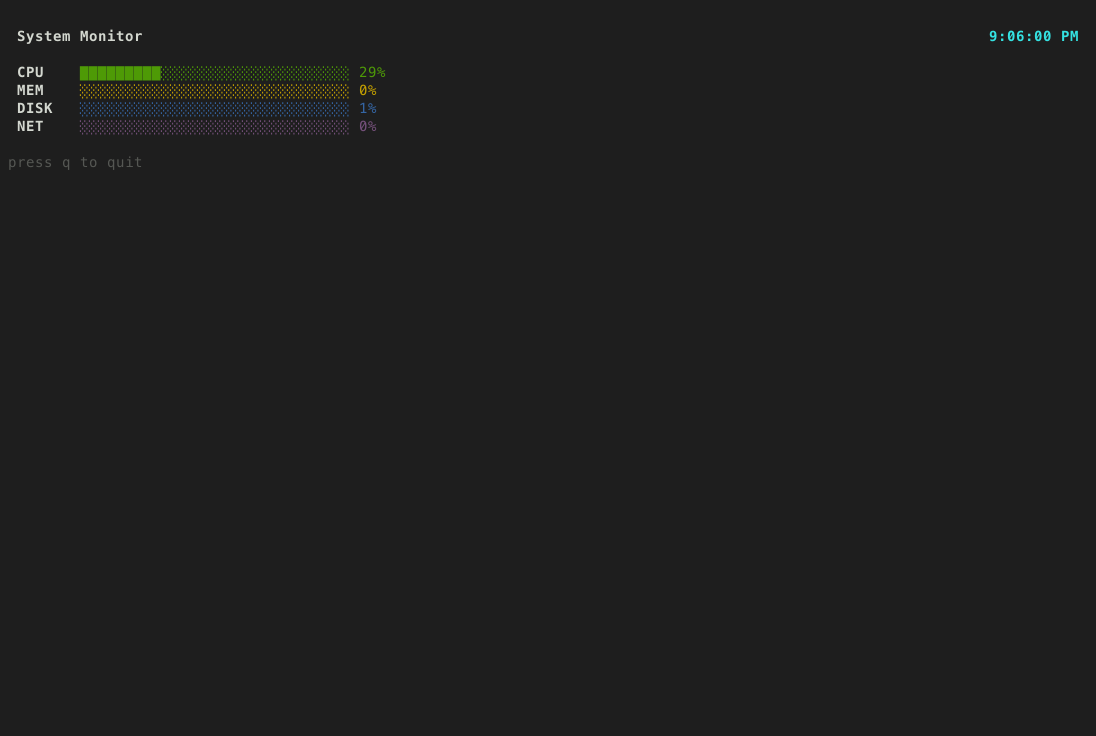
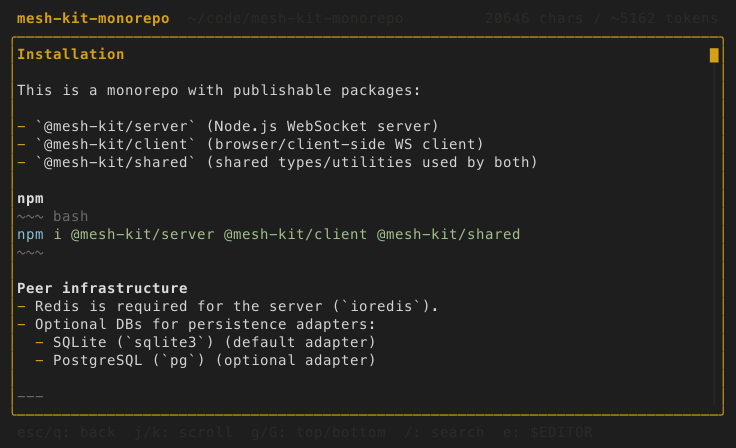
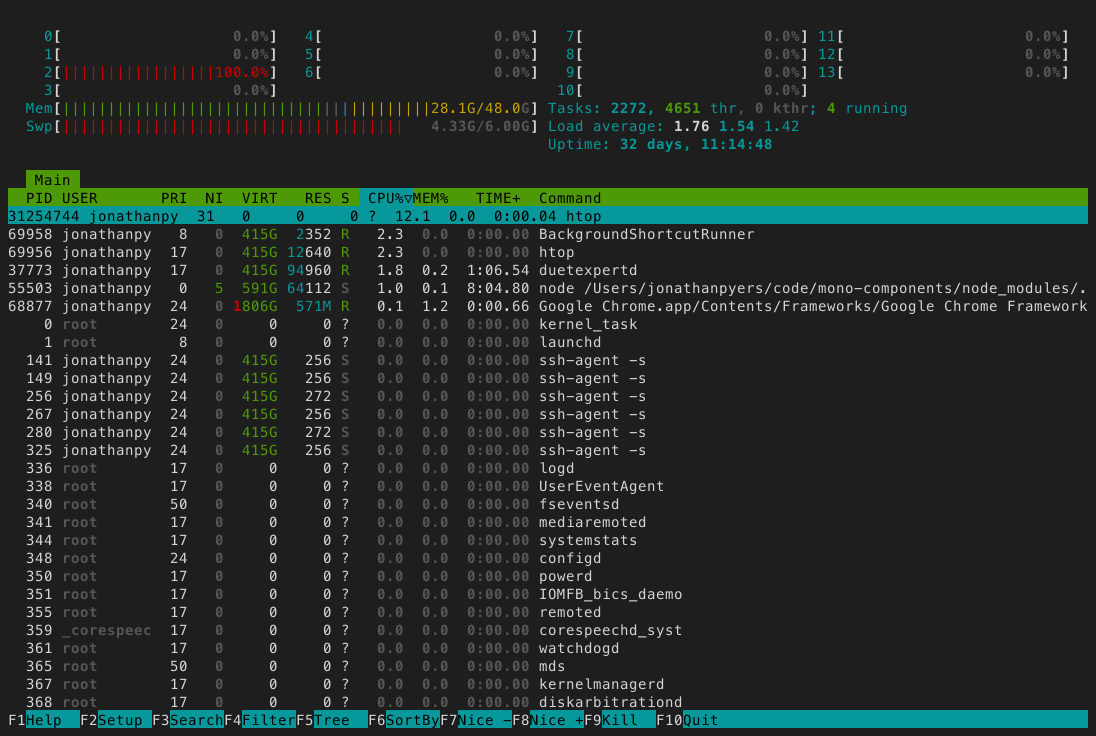
Some example outputs of the screenshot tool:
Setup
claude mcp add --scope user tui-mcp -- npx tui-mcp
Tools
| Tool | Description |
|---|---|
| launch | Spawn a TUI app in a managed pty |
| kill | Terminate a session |
| list_sessions | List sessions, including recently exited ones |
| status | Get one session's state and exit code |
| resize | Resize the terminal |
| screenshot | Capture terminal as PNG |
| snapshot | Capture terminal as plain text |
| scrollback | Read the buffer including scrolled-off history |
| output | Read the raw pty byte stream (escape sequences included) |
| read_region | Read a rectangular area of the buffer |
| cursor | Get cursor position |
| send_keys | Send a keystroke or combo (Enter, Ctrl+C, Ctrl+Up, q) |
| send_text | Type a string of characters |
| send_mouse | Send mouse events |
| wait_for_text | Wait for a regex pattern to appear |
| wait_for_idle | Wait until the terminal stops changing |
| wait_for_exit | Wait for the process to exit and get its exit code |
Interesting use cases
- remote ops: agent SSHs into a production box, tails logs, greps for errors, restarts a service, watches it come back up. it's reading the same terminal output a human SRE would see. no custom APIs needed.
- legacy system interaction: ncurses admin panels, mysql cli, redis-cli, psql - the agent can drive all of these. stuff that will never get a REST API.
- multi-session orchestration: agent launches 3-4 sessions simultaneously. one running a dev server, one running tests, one tailing logs, one in a debugger. it's basically pair programming with an extra set of hands.
- interactive debuggers: gdb, lldb, pdb, node --inspect. the agent can set breakpoints, step through code, inspect variables.
- infrastructure as conversation: kubectl, terraform, docker, aws cli. agent doesn't need the kubernetes MCP server or the AWS MCP server. it just uses the CLIs directly, same as a human would.
Most MCP servers wrap one specific tool or API. tui-mcp wraps the terminal itself, which is the universal interface that all tools already speak. It's MCP's eval().
Monitor
Watch and control all active sessions from your terminal:
npx tui-mcp monitor
Session list on the left, live ANSI-rendered terminal preview on the right. The monitor discovers every running tui-mcp server on the machine and aggregates their sessions.
Keys:
j/kor arrows to move through servers and their sessions,g/Gfor top/bottom, mouse click and scroll also workenteron a session attaches - everything you type passes through to its pty,ctrl+\detachesenteron a server opens the launch panel targeting itsfetches the session's full scrollback into a scrollable view,escreturns to livellaunches a new session on the selected row's server (ctrl+scycles the target)xtwice within 3 seconds kills the selected sessionqquits
Attach, launch, kill, and scrollback need the server to be 1.2 or newer; sessions on older servers are marked ro (read-only) and can still be watched.
How it works
your app  <-->  node-pty  <-->  xterm-headless  <-->  MCP tools
                (pty)        (terminal emulator)    (screenshot, send_keys, etc.)
The app runs in a real pseudo-terminal via node-pty. Its output is parsed by xterm-headless (the same terminal emulator that powers VS Code's terminal, but without a DOM). The MCP tools read and interact with that parsed buffer.
Install Tui in Claude Desktop, Claude Code & Cursor
unyly install tui-mcpInstalls into Claude Desktop, Claude Code, Cursor & VS Code — handles npx, uvx and build-from-source repos for you.
First time? Get the CLI: curl -fsSL https://unyly.org/install | sh
Or configure manually
Run in your terminal:
claude mcp add tui-mcp -- npx -y tui-mcpStep-by-step: how to install Tui
FAQ
Is Tui MCP free?
Yes, Tui MCP is free — one-click install via Unyly at no cost.
Does Tui need an API key?
No, Tui runs without API keys or environment variables.
Is Tui hosted or self-hosted?
Self-hosted: the server runs locally on your machine via the install command above.
How do I install Tui in Claude Desktop, Claude Code or Cursor?
Open Tui on unyly.org, pick your client tab (Claude Desktop, Claude Code, Cursor) and press Install — the config is generated automatically, no JSON editing.
Changes
Versions and requested access over time.
- New version published
- New version published
Related MCPs
Playwright
Browser automation, scraping, screenshots
 by Microsoft
Puppeteer
Browser automation and web scraping.
 by modelcontextprotocol
Higgsfield Unlimited
MCP server for Higgsfield AI that enables unlimited-mode image, video, audio generation, uploads, and job management via multiple parallel accounts, using brows
 by nukIeer
opentabs-dev/opentabs
Plugin-based MCP server + Chrome extension that gives AI agents access to web applications through the user's authenticated browser session. 100+ plugins with a
 by opentabs-dev
robhunter/agentdeals
1,500+ developer infrastructure deals, free tiers, and startup programs across 54 categories. Search deals, compare vendors, plan stacks, and track pricing chan
 by robhunter
hlydecker/ucsc-genome-mcp
MCP server to interact with the UCSC Genome Browser API, letting you find genomes, chromosomes, and more.
 by hlydecker
34892002/bilibili-mcp-js
A MCP server that supports searching for Bilibili content. Provides LangChain integration examples and test scripts.
 by 34892002
achiya-automation/safari-mcp
Native Safari browser automation for AI agents with 80+ tools. No Chrome dependency, optimized for Apple Silicon with 60% less CPU overhead.
 by achiya-automation
agent-infra/mcp-server-browser
Browser automation capabilities using Puppeteer, both support local and remote browser connection.
 by bytedance
aparajithn/agent-scraper-mcp
Web scraping MCP server for AI agents. 6 tools: clean content extraction, structured scraping with CSS selectors, full-page screenshots via Playwright, link ext
 by aparajithn
Compare Tui with
Not sure what to pick?
Find your stack in 60 seconds
Author?
Embed badge for your README
Browse similar
All browse MCPs