
Frontline Copilot Server
FreeNot checkedEnables store managers to query and triage customer review insights conversationally, including store health, open tasks, and critical alerts, by connecting Cla

About
Enables store managers to query and triage customer review insights conversationally, including store health, open tasks, and critical alerts, by connecting Claude Desktop to Airtable and Slack.
README
AI-powered review triage for retail store managers.
An always-on system that ingests customer reviews from any source, uses Claude to classify them by category and severity, and routes actionable ones to the store manager's Airtable task list — with real-time Slack alerts for critical issues (food safety, staff conduct, health risks).
Also ships as an MCP server so store managers can query and triage conversationally from Claude Desktop.
Inspired by the emerging category of AI copilots for store operations.
The problem
Store managers at multi-location retail chains drown in signal from customer reviews. Most are noise (praise or minor grumbles). A few are urgent (food safety, discrimination, injury risk). Most tools require the manager to read everything to find the few that matter — a losing battle at scale.
Frontline Copilot inverts this. Claude reads everything; the manager only sees what needs action.
How it works
┌────────────┐   ┌──────────────┐   ┌────────────┐   ┌────────────┐
│  Reviews   │──▶│ Classifier   │──▶│  Airtable  │──▶│   Slack    │
│  (JSON /   │   │ (Claude API, │   │  (task     │   │  (critical │
│   Google)  │   │  tool use)   │   │  tracker)  │   │   alerts)  │
└────────────┘   └──────────────┘   └────────────┘   └────────────┘
                        │
                        ▼
                 ┌──────────────┐
                 │  MCP server  │◀── Claude Desktop, Cursor, ...
                 │  (3 tools)   │
                 └──────────────┘
Each review is classified into one of nine categories with a severity from 1 (positive) to 5 (critical). Reviews at severity ≥ 3 become Airtable tasks; severity ≥ 4 additionally fire a Slack alert.
Screenshots
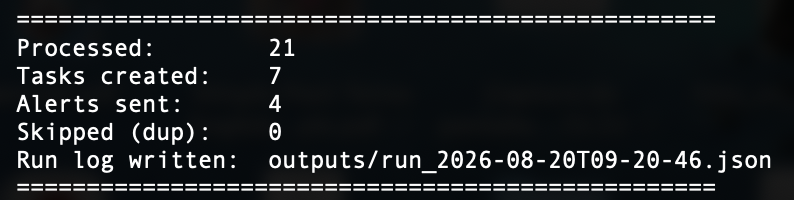
End-to-end pipeline run
21 reviews processed in ~60 seconds. 7 tasks created, 4 real-time critical alerts.
Airtable — task board
Tasks sorted by severity, colored by category. This is what a store manager sees.

Airtable — Kanban view
Same data, grouped by category. Distribution of issues at a glance.

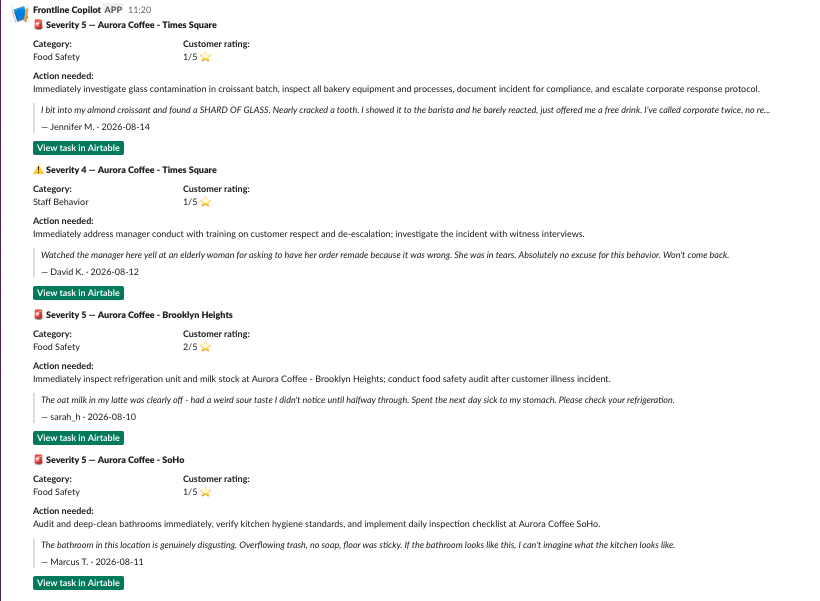
Slack — real-time critical alerts
Block Kit cards with action-first layout and direct link to the Airtable task.
Tech stack
- Python 3.10+ — dataclasses,
str | Noneunion types, pathlib - Anthropic Claude API — classification via tool use (
claude-haiku-4-5) - Airtable REST API — task tracker, called with raw
requests - Slack Incoming Webhooks — Block Kit for rich alert cards
- MCP (Model Context Protocol) — conversational interface via FastMCP
- Adapter pattern for review sources (Mock ships; Google Places stubbed)
Only three third-party deps: anthropic, requests, mcp. Everything else
is standard library.
Quick start
# 1. Clone and install
git clone https://github.com/miguelpomarm/frontline-copilot
cd frontline-copilot
python -m venv .venv && source .venv/bin/activate
pip install -r requirements.txt

# 2. Configure secrets
cp .env.example .env
# ... edit .env with your keys (see setup section below)

# 3. Run the pipeline
python triage.py

# 4. Launch as an MCP server (optional)
python mcp_server.py
Setup (one-time, ~10 minutes)
1. Anthropic API key
Get one at https://console.anthropic.com/. The free tier is enough for demo runs — 21 reviews cost ~$0.03.
2. Airtable base
Create a new base with a table named Tasks and these fields (exact names):
| Field | Type |
|---|---|
| Review ID | Single line text (primary field) |
| Store | Single line text |
| Category | Single select — populate with the 9 taxonomy values |
| Severity | Number (integer) |
| Summary | Long text |
| Review Text | Long text |
| Author | Single line text |
| Date | Date |
| Status | Single select — Open, In Progress, Resolved |
Then generate a personal access token at https://airtable.com/create/tokens
with data.records:read and data.records:write scopes on your base. Copy
the token and the base ID (starts with app..., found in the URL of your base).
3. Slack Incoming Webhook
Create a Slack app at https://api.slack.com/apps. Enable Incoming Webhooks, add a new webhook pointing to whichever channel should receive critical alerts, and copy the webhook URL.
4. Fill in .env
ANTHROPIC_API_KEY=sk-ant-...
AIRTABLE_API_KEY=pat...
AIRTABLE_BASE_ID=app...
AIRTABLE_TABLE_NAME=Tasks
SLACK_WEBHOOK_URL=https://hooks.slack.com/services/...
5. First run
python triage.py --limit 3 --dry-run   # sanity check, no side effects
python triage.py --limit 3             # small live run
python triage.py                       # full 21 reviews
MCP integration (Claude Desktop)
Add this to
~/Library/Application Support/Claude/claude_desktop_config.json (macOS) and
restart Claude Desktop:
{
  "mcpServers": {
    "frontline-copilot": {
      "command": "python",
      "args": ["/absolute/path/to/frontline-copilot/mcp_server.py"]
    }
  }
}
Then, inside Claude Desktop:
"How is Aurora Times Square doing right now?"
Claude will invoke get_store_health("times_square"), hit Airtable, and
respond with the current snapshot — open tasks, critical count, top category.
Design decisions
Deliberate choices worth calling out to a reviewer:
Closed taxonomy + Other bucket
Categories are a fixed enum, not free-form. This guarantees consistent routing
and metrics. Other is the escape hatch — reviewed periodically to expand the
taxonomy based on real data instead of upfront guessing.
Tool use over prompt engineering Claude returns structured output via a tool schema with enum enforcement. This eliminates parsing bugs and prevents the LLM from hallucinating a category outside the taxonomy.
Haiku 4.5 as the default model For a well-scoped classification task, Haiku is fast (sub-second), cheap (~$0.001 per review), and accurate enough. In production this decision alone saves thousands of dollars/month at moderate volume.
Adapter pattern for review sources
ReviewSource is an abstract interface. Ships with MockSource and a
documented GooglePlacesSource stub. Swapping to Yelp, TrustPilot, or a
proprietary feed is a new subclass — the rest of the pipeline is untouched.
Idempotency by review ID Reprocessing the same reviews doesn't create duplicate tasks. Airtable is checked before every create.
Severity thresholds as tunable constants
ACTION_THRESHOLD and ALERT_THRESHOLD are module-level. Customers with
different tolerances change two numbers, not code.
Sync over async for the MVP
Processes 21 reviews sequentially in ~40s. The async variant is ~15 lines to
swap (AsyncAnthropic + asyncio.gather with a semaphore for rate limits).
For this volume, readability wins over speed.
Text over stars The prompt explicitly tells Claude to weigh the review text over the star rating. A 4-star review mentioning food safety is severity 5, not 2.
Roadmap (not implemented)
- FastAPI webhook endpoint (
POST /webhook/review) for real-time ingestion instead of batch runs. GooglePlacesSource— the adapter interface is done, live implementation is ~1 hour of API integration + retry logic.- Rate-limit-aware async batching for high-volume production.
- End-to-end tests (Playwright / pytest with recorded API interactions) verifying the Airtable/Slack side effects.
- Per-customer configurable thresholds via
config.yaml.
License
MIT — see LICENSE.
Built by Miguel Pomar Martínez as a technical portfolio piece.
Installing Frontline Copilot Server
This server has no published package — it is built from source. Open the repository and follow its README.
▸ github.com/miguelpomarm/frontline-copilotFAQ
Is Frontline Copilot Server MCP free?
Yes, Frontline Copilot Server MCP is free — one-click install via Unyly at no cost.
Does Frontline Copilot Server need an API key?
No, Frontline Copilot Server runs without API keys or environment variables.
Is Frontline Copilot Server hosted or self-hosted?
A hosted option is available: Unyly runs the server in the cloud, no local setup required.
How do I install Frontline Copilot Server in Claude Desktop, Claude Code or Cursor?
Open Frontline Copilot Server on unyly.org, pick your client tab (Claude Desktop, Claude Code, Cursor) and press Install — the config is generated automatically, no JSON editing.
Related MCPs
Gmail
Read, send and search emails from Claude
 by Google
Slack
Send, search and summarize Slack messages
 by Slack
Runbear
No-code MCP client for team chat platforms, such as Slack, Microsoft Teams, and Discord.
Discord Server
A community discord server dedicated to MCP by [Frank Fiegel](https://github.com/punkpeye)
Klavis AI
Open Source MCP Infra. Hosted MCP servers and MCP clients on Slack and Discord.
Work90210/APIFold
Turn any REST API into a hosted MCP server. 18 free public servers (GitHub, Stripe, Slack, OpenAI, Notion, and more) — no setup required, bring your own API key
 by Work90210
arikusi/deepseek-mcp-server
MCP server for DeepSeek AI with chat, reasoning, multi-turn sessions, function calling, thinking mode, and cost tracking.
 by arikusi
hashgraph-online/hashnet-mcp-js
MCP server for the Registry Broker. Discover, register, and chat with AI agents on the Hashgraph network.
 by hashgraph-online
profullstack/mcp-server
A comprehensive MCP server aggregating 20+ tools including SEO optimization, document conversion, domain lookup, email validation, QR generation, weather data,
 by profullstack
WayStation-ai/mcp
Seamlessly and securely connect Claude Desktop and other MCP hosts to your favorite apps (Notion, Slack, Monday, Airtable, etc.). Takes less than 90 secs.
 by waystation-ai
Compare Frontline Copilot Server with
Not sure what to pick?
Find your stack in 60 seconds
Author?
Embed badge for your README
Browse similar
All communication MCPs