
Davinci Resolve Lite
FreeNot checkedMCP server that lets an AI client control DaVinci Resolve, including the free Lite edition

About
MCP server that lets an AI client control DaVinci Resolve, including the free Lite edition
README
test PyPI MCP Registry License: MIT Python 3.9+ Platform: macOS DaVinci Resolve: Lite \| Studio 163 tools Zero dependencies
https://github.com/user-attachments/assets/8429932f-643b-4131-bdf6-dad0d3399137
Claude builds an opening title in DaVinci Resolve Lite — a gold "GameHelper"
Text+ node with glow and a zoom-in keyframe reveal — from a plain-language
request, via insert_fusion_title + style_fusion_title.
An MCP server that lets an AI client such as Claude Code control DaVinci Resolve — including the free (Lite) edition, which the existing davinci-resolve-mcp project cannot drive.
The free edition blocks external scripting, but it still runs Python scripts launched from its own Workspace > Scripts menu. This project rides that path: the MCP server runs inside Resolve as a menu script, and exposes Resolve's Python API over a small local HTTP endpoint that Claude connects to.
Claude Code ──HTTP JSON-RPC (MCP)──▶  127.0.0.1:8765/mcp
                                          │   server runs INSIDE Resolve
                                          │   (Workspace > Scripts > Utility)
                                          ▼
                              command queue → main script thread
                                          ▼
                              global `resolve` object → Resolve API
Tools
Ask Claude in plain language; it drives Resolve through the tools — see the demo above. See the tools reference for the full 163-tool surface — editing, color, render, media pool, and Fusion title styling.
Why this works on the free edition
- Free Resolve permits scripts run from its Scripts menu (only external network scripting is restricted).
- A menu script gets the
resolveobject for free and may run a long-lived loop — long enough to host a server. - The sandboxed Lite app ships the
com.apple.security.network.serverentitlement, so it can open a localhost listening socket. - Zero dependencies — pure Python standard library. Nothing to
pip installinto Resolve's interpreter.
Requirements
- macOS with DaVinci Resolve (Lite/free or Studio).
- Claude Code (or any MCP client that speaks the Streamable HTTP transport).
Install
git clone https://github.com/2sem/davinci-resolve-lite-mcp.git
cd davinci-resolve-lite-mcp
./install.sh
Or via pip, if you'd rather not clone the repo:
pip install davinci-resolve-lite-mcp
davinci-mcp-install
davinci-mcp-install does exactly what install.sh does (same Lite/Studio
detection, same copy-vs-symlink logic) — it just reads the files from your
pip-installed package instead of a git checkout. davinci-mcp-uninstall
reverses it. Either way, the sandbox note below still applies, and you still
start the server from Resolve's own menu — see Run.
macOS user-install note. If you see
Defaulting to user installation because normal site-packages is not writeable, pip installed the console scripts under$(python3 -m site --user-base)/bin, which usually isn't onPATH. Either run the full path —"$(python3 -m site --user-base)/bin/davinci-mcp-install"— or add thatbindirectory toPATH. And use&&, not&, between the two commands: a bare&backgroundspip installand racesdavinci-mcp-installbefore the package exists.
Also listed on the MCP Registry as
io.github.2sem/davinci-resolve-lite-mcp
(verify) —
for discoverability only. The listing is metadata-only (no auto-install
packages/remotes entry): this server can't be spawned by an MCP client the
way a typical registry server can, since it must run inside Resolve's own
embedded Python interpreter, started by hand from the Scripts menu. Install it
one of the two ways above.
install.sh deploys:
- the two launcher scripts into
Fusion/Scripts/Utility(a folder Resolve scans for the Scripts menu; Utility shows on every page), and - the
resolve_mcppackage intoFusion/Scripts/MCP— a folder Resolve does not scan, so the helper modules stay out of the menu.
The Lite container path is detected automatically.
Sandbox note (important). DaVinci Resolve Lite is sandboxed and can only read its own container,
~/Movies, and files you pick interactively. A symlink that points outside those locations (e.g. into a clone under~/Projects) cannot be followed by the sandboxed app, so the menu script would silently never run. For that reasoninstall.shcopies the files into the container on Lite (and symlinks only on the non-sandboxed Studio build). Re-run./install.shafter pulling updates.Resolve enumerates only the category folders (
Utility / Comp / Tool / Edit / Color / Deliver) for its Scripts menu — that is why the launchers go inUtilityand the package hides inMCP.The same sandboxing applies to file paths you ask the tools to use: exports/imports should target
~/Movies(or other granted locations), otherwise Resolve cannot write/read them.
Run
In DaVinci Resolve: Workspace > Scripts > Utility > davinci_mcp_server.
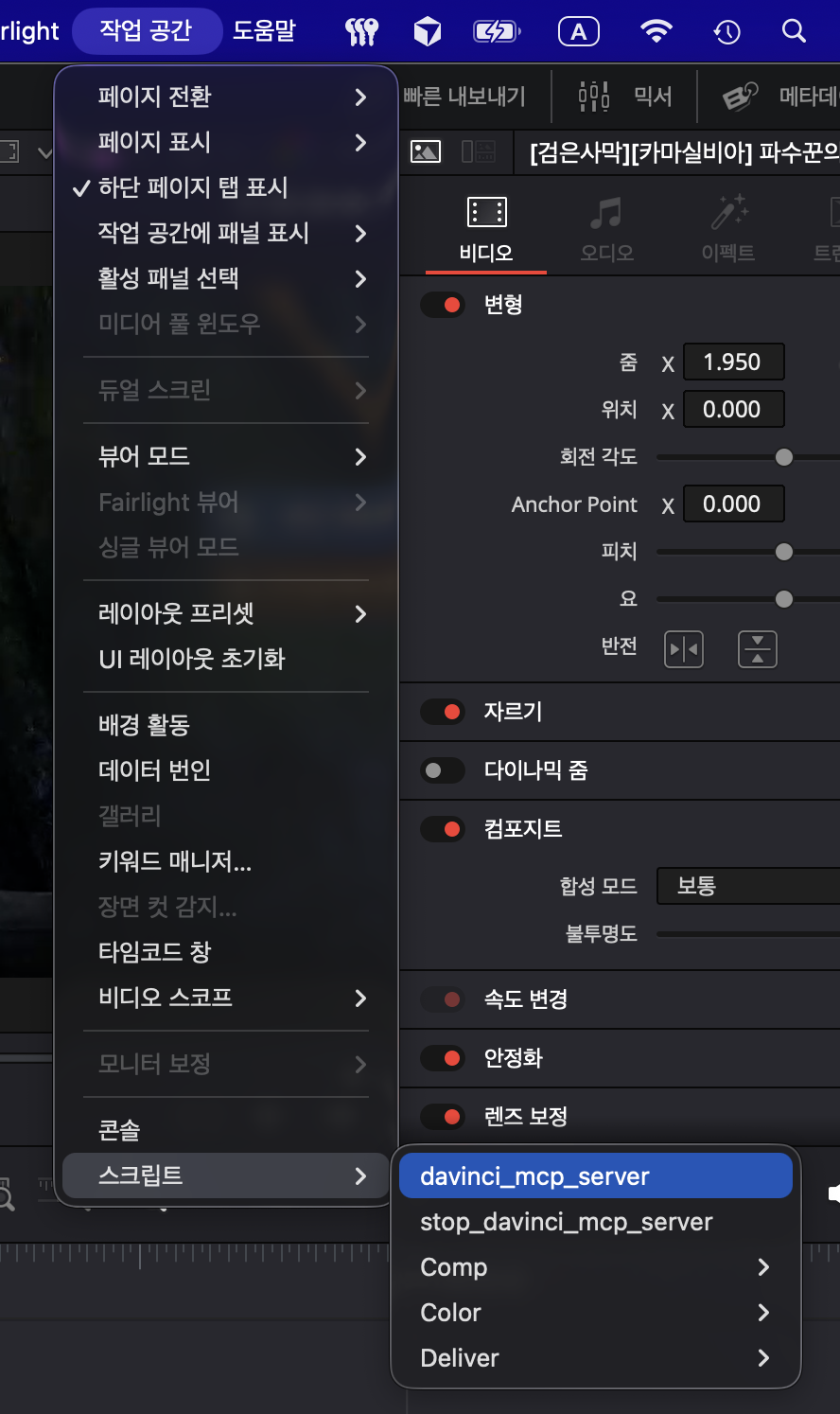
Open Workspace > Console — it prints the endpoint and port:
MCP endpoint:  http://127.0.0.1:8765/mcp
Add to Claude Code:
  claude mcp add --transport http davinci http://127.0.0.1:8765/mcp
The startup guide prints to the Resolve Console (Workspace > Console). Because the server runs continuously, its Console output can buffer until it stops, so both scripts also mirror every line to a logfile:
~/Movies/davinci-resolve-lite-mcp.logWatch it live with
./logs.sh. (Override the directory withDAVINCI_MCP_LOG_DIR.)~/Moviesis used because the sandboxed Lite app is allowed to write there.Once running, every tool call is logged to the Console as a single line (
[davinci-mcp] <name> <args> -> ok|error (Nms)):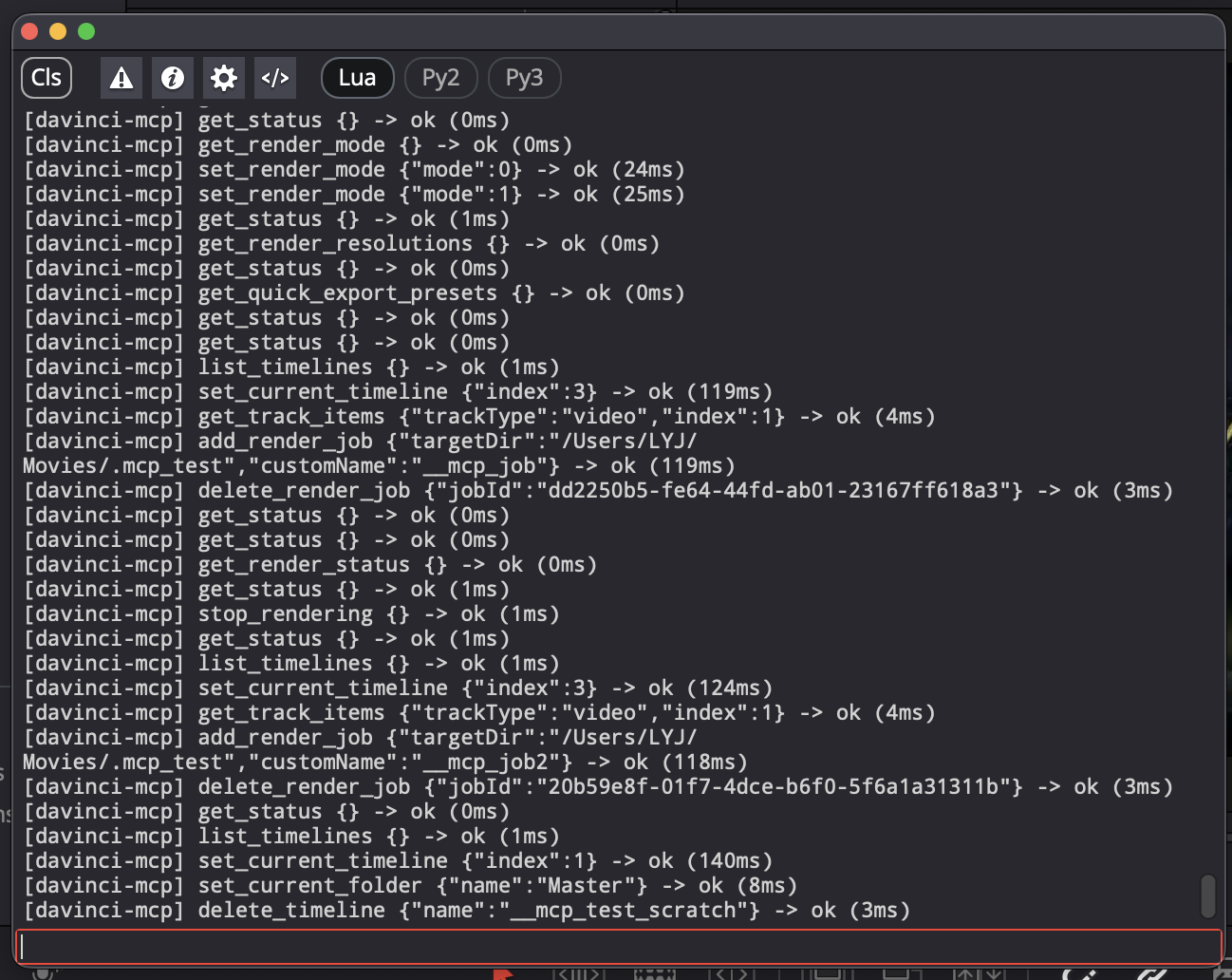
Update check. Like
brew/CocoaPods, each launch checks PyPI in the background for a newer release and prints a one-line nudge to the Console if one exists — never blocks startup, and any failure (offline, PyPI down) stays silent in the logfile only. Disable withDAVINCI_MCP_SKIP_UPDATE_CHECK=1.Register it with Claude Code (one-time):
claude mcp add --transport http davinci http://127.0.0.1:8765/mcpThen verify / reconnect with the
/mcpcommand inside Claude Code — it lists connected servers and reconnects them. If Claude was already running when you launched the script, type/mcp(or restart the session) so it picks up thedavinciserver.Ask Claude to control Resolve.
Configure the port (stable, recommended)
By default the server listens on 8765 and auto-increments to 8766, 8767,
… if that port is busy (another local tool may already hold 8765). Because
the winner of that race can change between launches, the URL you registered with
Claude can drift, surfacing as:
Failed to reconnect to davinci: HTTP 404 at http://127.0.0.1:8765/mcp
To lock the port for good, drop a small JSON config file. When a port is set this way it is pinned — the server binds exactly that port and never auto-increments, so you register Claude once and the URL never moves.
Create ~/Movies/davinci-resolve-lite-mcp.config.json:
{ "host": "127.0.0.1", "port": 8770 }
Why
~/Moviesand not~/.config? The Lite app is sandboxed and can only read its own container,~/Movies, and files you pick interactively —~/.configis outside the sandbox, so Lite cannot read it (this is the same reason the logfile lives in~/Movies). The server also checks~/.config/davinci-resolve-lite-mcp/config.jsonfor the non-sandboxed Studio build, where that path is conventional.
Then restart the server (Scripts > Utility > stop_davinci_mcp_server, then davinci_mcp_server) and register Claude once at the fixed port:
claude mcp add --transport http davinci http://127.0.0.1:8770/mcp
The Console banner confirms the source — look for
Port : pinned (from …) — will not auto-increment.
Resolution order (highest priority first): the DAVINCI_MCP_PORT /
DAVINCI_MCP_HOST environment variables, then the config file, then the
built-in defaults. The env vars also pin the port, but a Dock-launched Resolve
won't see a shell export; the config file is the simplest persistent option.
DAVINCI_MCP_CONFIG=/path/to.json forces a specific config file exclusively
— if that path is missing or malformed the server falls back to the built-in
defaults rather than reading ~/Movies / XDG.
If the port already drifted and Claude points at the wrong one, re-point it:
claude mcp remove davinci
claude mcp add --transport http davinci http://127.0.0.1:<actual-port>/mcp
Stopping
Any of these stops the server:
- From the menu: Workspace > Scripts > Utility > stop_davinci_mcp_server
- From a terminal:
./stop.sh - Quit DaVinci Resolve
The menu stop script and stop.sh both POST to the server's /shutdown
endpoint, scanning the same port range the server uses on startup.
The port auto-increments from
8765only when it is not pinned. To lock it so the URL never moves between launches, see Configure the port.
Tools
163 tools, spanning the full pipeline:
- Status & navigation — page switching, project/timeline settings
- Projects & timelines — load/create/duplicate, markers, scene cuts, lifecycle
- Tracks — add/delete, enable/lock/rename
- Editing — place/append/delete clips, titles & generators, transform/crop/zoom
- Media pool & storage — import/delete, properties & metadata, tagging, disk browse
- Color — node graph LUT/enable, reset grades, stills
- Render & export — render queue, formats/codec, frame/timeline/project export & import
See docs/TOOLS.md for the complete per-tool reference.
Every tool call is logged to the Resolve Console and the logfile as a single
line: [davinci-mcp] <name> <args> -> ok|error|EXCEPTION (Nms).
Project layout
src/davinci_mcp_server.py        thin launcher (deployed to Scripts/Utility)
src/stop_davinci_mcp_server.py   stop launcher
src/resolve_mcp/                 the server package (deployed to Scripts/MCP, hidden)
    config · logio · connection · bridge · tools · server
tests/test_server.py             offline tests (fake Resolve, no app needed)
install.sh · uninstall.sh · stop.sh · logs.sh
docs/TOOLS.md                    full per-tool reference
fallbacks/                       documented gotchas + fixes
Testing
- Offline (no Resolve, no server) — import + dispatcher + tool-count smoke:
python3 tests/test_server.py - Live integration — one test per tool against a running server (Resolve open
with a project + a media clip, and
davinci_mcp_serverlaunched):
Each test name equals the tool name, so when you change a tool you can run just its test:python3 tests/live_test.py # all features python3 tests/live_test.py set_timecode # run the test(s) for given feature(s)python3 tests/live_test.py <tool>. Tests are reversible (scratch timeline + temp files, cleaned up). File-dependent and session-destructive tools are checked via their error path; Studio-only / heavy tools (e.g.detect_scene_cuts,render_current_timeline,quick_export) are skipped with a reason. A few marker / still tests depend on a clean Resolve session state — re-run them after a fresh launch if they flake.
Contributing
See CONTRIBUTING.md for how to add a tool, run the suites, the stdlib-only / Lite-first constraints, and the release flow.
Scope
This server targets the free (Lite) edition and intentionally covers only
API that runs there. Studio-only / paid features are deliberately omitted
(they no-op or error on Lite), namely: audio transcription, subtitles-from-audio,
Magic Mask, Stabilize, Smart Reframe, Dolby Vision analysis, Voice Isolation,
and cloud projects / database management. The remaining unwrapped methods are
trivial accessors (GetUniqueId, cache modes, Fusion-comp internals, takes,
stereo/3D, layout & burn-in presets, mattes) — not functional gaps.
Known limitations
- Clips can be addressed by name (within the current media-pool folder) or
by id (
id/ids, resolvable across any bin) — passid/idswhen names are ambiguous or the clip lives in another folder. - Tool arguments are validated against each tool's JSON Schema (required fields, basic types, and enums); a malformed call returns a clear error naming the offending argument. Deep/nested schema constraints are not exhaustively checked.
Security note
The server binds to 127.0.0.1 only, so it is reachable from your machine
only. It exposes control of DaVinci Resolve to any local process that can reach
the port — only run it on a machine you trust.
The one outbound call the server makes on its own is the startup update check
(a GET to PyPI's public JSON API for the current version number — no other
data sent). Disable it with DAVINCI_MCP_SKIP_UPDATE_CHECK=1 if you'd rather
it made none.
License
MIT — see LICENSE.
Install Davinci Resolve Lite in Claude Desktop, Claude Code & Cursor
unyly install davinci-resolve-liteInstalls into Claude Desktop, Claude Code, Cursor & VS Code — handles npx, uvx and build-from-source repos for you.
First time? Get the CLI: curl -fsSL https://unyly.org/install | sh
Or configure manually
Run in your terminal:
claude mcp add davinci-resolve-lite -- uvx davinci-resolve-lite-mcpStep-by-step: how to install Davinci Resolve Lite
FAQ
Is Davinci Resolve Lite MCP free?
Yes, Davinci Resolve Lite MCP is free — one-click install via Unyly at no cost.
Does Davinci Resolve Lite need an API key?
No, Davinci Resolve Lite runs without API keys or environment variables.
Is Davinci Resolve Lite hosted or self-hosted?
Self-hosted: the server runs locally on your machine via the install command above.
How do I install Davinci Resolve Lite in Claude Desktop, Claude Code or Cursor?
Open Davinci Resolve Lite on unyly.org, pick your client tab (Claude Desktop, Claude Code, Cursor) and press Install — the config is generated automatically, no JSON editing.
Related MCPs
Fetch
Web content fetching and conversion for efficient LLM usage.
AWS KB Retrieval
Retrieval from AWS Knowledge Base using Bedrock Agent Runtime.
 by modelcontextprotocol
Spring AI MCP Server
Provides auto-configuration for setting up an MCP server in Spring Boot applications.
llm-analysis-assistant
A very streamlined mcp client that supports calling and monitoring stdio/sse/streamableHttp, and can also view request responses through the /logs page. It also
 by xuzexin-hz
MCP-Agent
A simple, composable framework to build agents using Model Context Protocol by [LastMile AI](https://www.lastmileai.dev)
 by lastmile-ai
Spring AI MCP Client
Provides auto-configuration for MCP client functionality in Spring Boot applications.
mcp.natoma.ai
A Hosted MCP Platform to discover, install, manage and deploy MCP servers by [Natoma Labs](https://www.natoma.ai)
MCPHub
Website to list high quality MCP servers and reviews by real users. Also provide online chatbot for popular LLM models with MCP server support.
MCP Servers Rating and User Reviews
Website to rate MCP servers, write authentic user reviews, and [search engine for agent & mcp](http://www.deepnlp.org/search/agent)
mkinf
An Open Source registry of hosted MCP Servers to accelerate AI agent workflows.
Compare Davinci Resolve Lite with
Not sure what to pick?
Find your stack in 60 seconds
Author?
Embed badge for your README
Browse similar
All ai MCPs