
Cqfi
FreeNot checkedHave an LLM control QuantLib, the cache, your databases and any plug-in tools. Includes evaluator framework and an Excel/LibreOffice API in https://github.com/F

About
Have an LLM control QuantLib, the cache, your databases and any plug-in tools. Includes evaluator framework and an Excel/LibreOffice API in https://github.com/FulgentMcGuffin/cqfi-xl and makes use of https://github.com/FulgentMcGuffin/mcp_data
README
⭐ If you find this repository useful, please consider starring it.
Interactive agent for QuantLib fixed-income analytics on government bonds. and their exchange-traded futures.
Yield-curve inputs come from a read-only DuckDB or SQLite database (ycs_data);
session analytics are written to a separate quant cache database (quant_cache_db);
bond universes and durable analytics live in bond analytics (bond_analytics_db);
and all three datasets are queryable through an LLM using mcp-data.
Available as both a terminal CLI (cqfi) and a GUI chat window (cqfi-gui).
Features
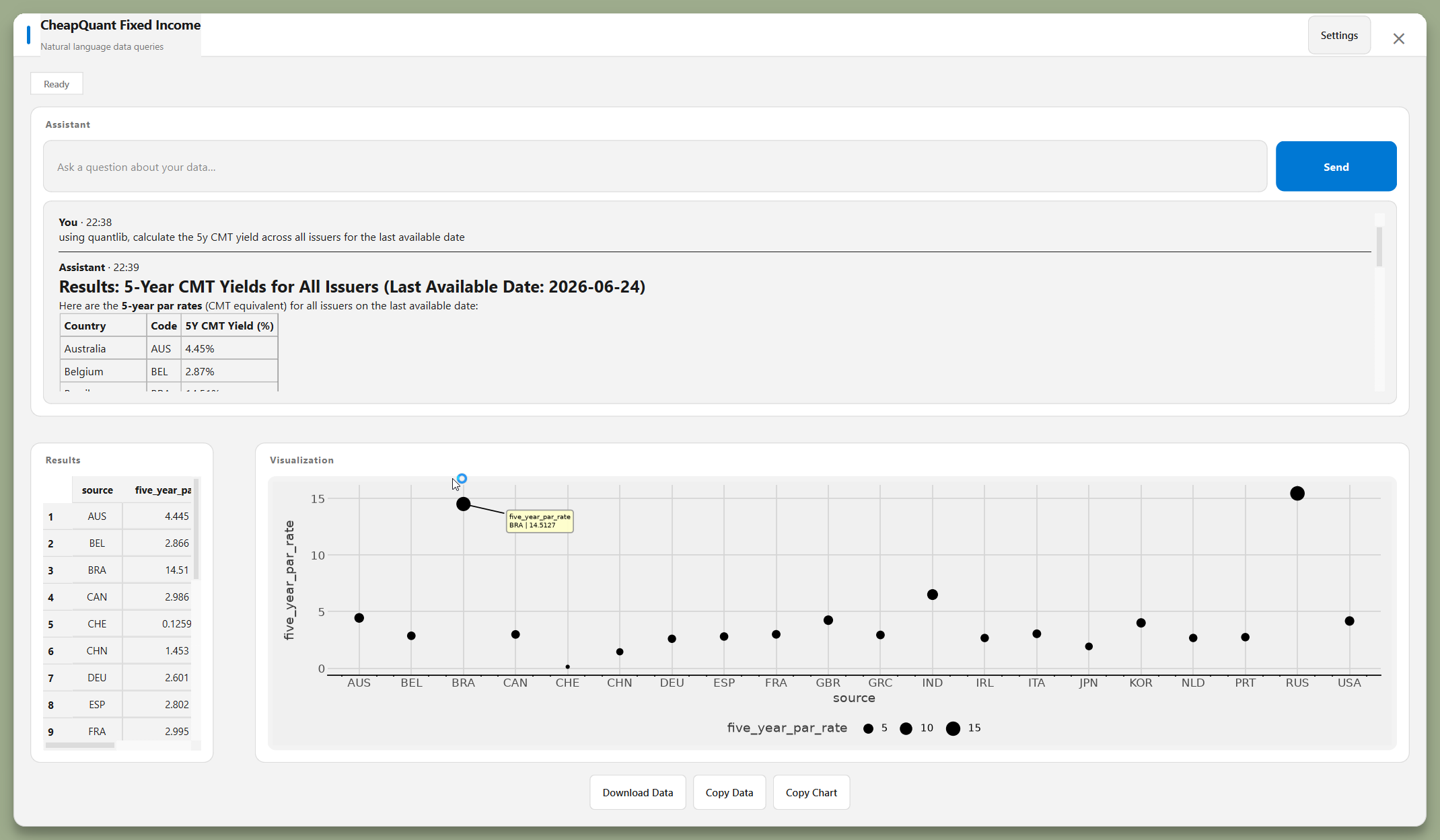
cqfi is built around natural language: you describe what you want, the agent chooses tools and data sources, returns structured feedback, and (in the GUI) renders tables and charts from the result.
What you can do today
QuantLib pricing & analytics — bootstrap yield curves (19 sovereign issuers, 18 interpolation/fitting methods), price CMTs, and compute bond/CMT analytics: yield, duration, convexity, z-spread, par yield, curve zero rate, carry, and yield rolls (spot and forward at 1m/3m/6m/1y horizons). Bond analytics also return maturity-matched par-yield and fixed-coupon CMT comparables.
Market context — lazy-built
QuantlibMarketContextobjects keyed by valuation date and issuer. Curves are loaded fromycs_dataon demand and cached in a process-wide singleton. Use/mctxin the CLI or GUI, or thecheck_market_contextLLM tool, to verify/build curves.Swap and repo curves — per-currency swap par curves (
swap_par_rates) and repo / risk-free funding curves (repo_rfr_rates) fromycs_data, for AUD, CAD, CHF, EUR, GBP, JPY, NOK, NZD, SEK and USD. Repo curves are bootstrapped from par-style term quotes; swap curves are dual-curve, discounted off the same-currency repo curve (self-discounting when no repo quote exists that day). They are keyed by two deliberately distinct types —SwapCurveKeyandRepoCurveKey— and stored in the market context underSWAP_PAR/REPO_RFR. View any curve (bond, swap or repo) as a pillar table and chart with/curveor theget_curve/list_curvesLLM tools.Bond lookup — look up individual bonds from
bond_universebyuser_friendly_idorbond_idvia/bond,@mentionsyntax, or theget_bondLLM tool. Bonds deserialize into typedBondobjects viaBondManager.Bond analytics — compute fixed-income metrics using
/calc <bond_id> …or thecompute_bond_analyticsLLM tool. Trade date and curve label are optional (default to latest date andBOND_ZERO).CMT analytics — compute forward-starting constant-maturity treasury (CMT) analytics using
/calc <issuer> <composite_tenor> [trade_date]or thecompute_cmt_analyticsLLM tool. The composite tenor combines a forward start and forward end (e.g.5y,10y2y,18m4w9m4d). Trade date defaults to the latestzero_ratesdate for that issuer. The CMT is priced at par on the curve (unadjusted coupon schedule, like other CMTs).Bond Future analytics — a static registry of 30 exchange-traded government bond future contracts (CME, Eurex, ICE and the Osaka Exchange; 9 sovereign issuers) with exchange-specific conversion-factor formulas, delivery calendars, and basket eligibility rules (remaining maturity, original term, minimum issue size, green exclusion). Build a delivery basket — every eligible bond from
bond_universe, or an explicit list with optional hard-coded conversion factors — with/dlv <name> <future> [bonds...] [delivery], then compute conversion factor, implied repo rate, gross and net basis, delta, gamma and implied fair futures price (cheapest-to-deliver first) with/fut <basket|contract> [trade_date] [repo], or thebuild_delivery_basket/compute_bond_future_analyticsLLM tools. An optional repo argument — a flat rate held for eternity, or a full tenor curve — feeds the carry-to-delivery calculation for every bond in the basket; without one, each bond's own discount-curve forward rate is used instead. The Python API goes one step further and lets an individual deliverable bond carry its own repo term structure (DeliveryBasket.add(..., repo_term_structure=...)/set_repo_term_structure), overriding the basket-wide curve for that bond only.Three queryable datasets (auto-routed by keyword, or forced with a prefix):
Prefix Database Typical questions input:ycs_dbzero/par rates, swap par rates, repo/RFR rates, FX, correlations, curve slopes cache:quant_cache_dbsession bond/CMT analytics, calculation log bond_analytics:bond_analytics_dbbond universe, stored bond/CMT analytics, bond future conventions and basis analytics Session quant cache — when enabled,
/calc(bond or CMT),/fut, and thecompute_bond_analytics,compute_cmt_analytics, andcompute_bond_future_analyticstools persist rows toquant_cache_db(bond_analytics,cmt_analytics,bond_future_basket_outputs,bond_future_outputs). Toggle at runtime with/cache on|off. On application exit,/save_cachecontrols whether those rows merge intobond_analytics_db(includingbond_future_conventionsupserts) or are discarded.Named cache sessions — save/load full
quant_cache_dbsnapshots undersessions_dirto compare runs (save,load,sessions,reset cache).Mix and match — pull a curve from
ycs_data, ensure market context exists, compute bond analytics, optionally cache results, then query them withcache:orbond_analytics:prefixes. Or build a delivery basket with/dlv, run/futwith a repo curve across several trade dates, and compare the cheapest-to-deliver bond and its net basis over time.Batch bond and bond-future analytics — compute analytics for every active bond (or every dated futures contract in a delivery cycle) across a trade-date range, writing results straight into
bond_analytics_db. Run from the standalone CLI (batch_bond_analytics.py) or launch the same progress GUI from the REPL with/batch. See Batch processing.
On the roadmap
- Plug-in user tools — register custom Python callables as agent tools alongside the built-in QuantLib and SQL paths.
Interfaces
cqfi(CLI) — interactive REPL with dataset prefixes, slash commands, direct pricing, session save/load, and runtime cache toggles.cqfi-gui(GUI) — PySide6 chat window with the same routing and slash commands as the CLI: Markdown replies, sortable tables, plotnine charts, Download/Copy actions, and plot/table settings.
Setup
cd D:\Code\cqfi
uv sync
copy .env.example .env   # optional — set ANTHROPIC_API_KEY for LLM mode
Paths are configured in config/cqfi.yaml, shared by both cqfi and
cqfi-gui. Override with --config or the CQFI_CONFIG environment variable.
Optional per-path overrides live in .env (see .env.example).
On startup, ycs_db, bond_analytics_db, and quant_cache_db must resolve to
distinct paths; the same applies to the three semantics profiles.
| Setting | Config key | Default |
|---|---|---|
| YCS DB | paths.ycs_db |
D:/data/duckdb/ycs_data.duckdb |
| YCS semantics | paths.ycs_semantics |
./semantics/ycs_data.yaml |
| Bond analytics DB | paths.bond_analytics_db |
D:/data/duckdb/bond_analytics.duckdb |
| Bond analytics semantics | paths.bond_analytics_semantics |
./semantics/bond_analytics.yaml |
| Quant cache DB | paths.quant_cache_db |
D:/data/duckdb/quant_cache.duckdb |
| Quant cache semantics | paths.quant_cache_semantics |
./semantics/quant_cache.yaml |
| Sessions | paths.sessions_dir |
./data/sessions/ |
Tutorial notebooks
Jupyter tutorials live under notebooks/. They exercise the same Python API as the snippets below (typed inputs, QuantLib calculators, delivery baskets) without going through the CLI.
| Notebook | Contents |
|---|---|
| notebooks/bond_and_bond_future_analytics.ipynb | End-to-end bond, CMT, and bond-future analytics: first with registry objects (ISSUERS, BOND_FUTURE_CONVENTIONS, BondManager / DeliveryBasket.auto), then with user-built IssuerProfile, Bond, BondFutureConvention, and baskets (including CF overrides, repo curves, implied vs quoted futures prices). |
cd D:\Code\cqfi
uv sync                 # installs jupyter / ipykernel in the dev group
uv run jupyter lab      # or: uv run jupyter notebook
# Open notebooks/bond_and_bond_future_analytics.ipynb and select the .venv kernel
ycs_db and bond_analytics_db (see config/cqfi.yaml) are optional: when
present the notebook uses live curves and bond_universe baskets; otherwise it
falls back to in-memory bonds and a flat discount curve so every section still
runs offline.
Runtime settings
Mutable session behaviour is stored in ~/.cqfi/cqfi_runtime.json (override
with CQFI_RUNTIME_CONFIG). Values load on startup and save on exit.
| Setting | Slash command | Effect |
|---|---|---|
use_quant_cache |
/cache on|off |
Write /calc and analytics-tool results to quant_cache_db during the session |
save_quant_cache_to_bond_analytics_after_session |
/save_cache on|off |
On exit: merge cache rows into bond_analytics_db, or delete cache rows only |
Build or refresh the bond analytics database (schema + CSV seed data):
uv run python -m cqfi.data.create_bond_analytics_db
CLI usage (cqfi)
uv run cqfi
uv run cqfi --config config/cqfi.yaml
uv run main.py        # IDE-friendly: auto-relaunches via .venv
Dataset queries
cqfi> input: average 10Y zero rate for Germany in 2012
cqfi> cache: show bond analytics computed this session
cqfi> bond_analytics: show bonds for France maturing after 2030
Prefixes are optional when the question clearly targets one dataset (e.g.
"zero rate" → input:, "cached analytics" → cache:, "bond universe" →
bond_analytics:).
Direct commands
Pricing
cqfi> price cmt USA 2020-01-02
cqfi> price cmt DEU 2019-06-14 --par
CMT pricing reads ycs_data and returns a DataFrame; it does not write to
quant_cache_db.
Market context
cqfi> /mctx 2024-02-15              # Check all curves for the date
cqfi> /mctx 2024-02-15 USA          # Check USA market for the date
cqfi> /mctx 2024-02-15 USA BOND_ZERO
cqfi> /mctx 2024-02-15 USD SWAP_PAR # Build the USD swap curve (currency, not issuer)
cqfi> /mctx                         # Show /mctx help
Curves
cqfi> /curve swap USD 2024-01-02          # USD swap par curve (dual-curve, off repo)
cqfi> /curve repo EUR 2024-01-02          # EUR repo/RFR funding curve
cqfi> /curve swap EUR 2024-01-02 6M 1Y    # explicit float / fixed periods
cqfi> /curve bond DEU 2024-01-02          # sovereign zero curve (bond_par for par)
cqfi> /curve list 2024-01-02              # swap/repo curves quoted that day
cqfi> /curve                              # Show /curve help
Each run returns one row per pillar: tenor_years, tenor_label,
input_rate_pct, zero_rate_pct and, for swap and repo curves,
discount_factor, fwd_rate_pct (simple forward over the float period) and
discounting (repo or self). In the GUI the table is also plotted.
Periods default to the only combination quoted for that currency; pass them
explicitly when more than one exists.
Bond curves use a fixed 13-pillar set (BOND_TENOR_COLUMNS); the extra 3M, 6Y,
8Y and 9Y columns are only used by swap and repo curves.
Bond lookup
cqfi> /bond usa10y001
cqfi> /bond fraapr029
cqfi> @fraapr029                    # bare @mention shorthand
cqfi> /bond                         # Show /bond help
Bond and CMT analytics
/calc supports two forms. Bond form:
cqfi> /calc fraapr029
cqfi> /calc usa10y001 2024-02-15
cqfi> /calc fraapr029 2024-02-15 BOND_PAR
CMT form — issuer plus composite tenor, optional trade date:
cqfi> /calc DEU 5y                      # 5Y CMT, latest zero_rates date for DEU
cqfi> /calc FRA 10y2y                   # forward 10y2y CMT for France
cqfi> /calc DEU 18m4w9m4d 2024-02-15    # explicit trade date
cqfi> /calc                             # Show /calc help (both forms)
| Argument | Bond form | CMT form |
|---|---|---|
| 1st | bond_id or user_friendly_id |
Issuer code or alias (DEU, FRA, usa, …) |
| 2nd | Optional YYYY-MM-DD trade date |
Composite tenor string (5y, 10y2y, …) |
| 3rd | Optional curve label (BOND_ZERO, BOND_PAR) |
Optional YYYY-MM-DD trade date |
| 4th | Optional JSON repo term structure | — |
When /cache on is active, bond runs write bond + linked maturity-matched CMT
rows to quant_cache_db; standalone CMT runs write one row to cmt_analytics
(is_fixed_coupon = 0).
Bond futures
/dlv builds and names a delivery basket; /fut runs basis analytics against
a stored basket or a contract code, cheapest-to-deliver first.
cqfi> /dlv mybasket FGBM                              # front Euro-Bobl basket
cqfi> /dlv mine FOA fraapr029|1.0326 frajun030 2025-12 # explicit bonds, one with a hard-coded factor

cqfi> /fut IKH7                                       # latest available trade date
cqfi> /fut IKH7 2026-05-15                             # explicit trade date
cqfi> /fut mybasket 2025-10-15                         # a basket stored earlier by /dlv
cqfi> /fut IKH7 2026-05-15 3.0                         # flat 3% repo rate, held for every tenor
cqfi> /fut IKH7 2026-05-15 {"3m": 3.0, "1y": 3.2}      # full repo curve
The optional repo argument on /fut is applied to every bond in the delivery
basket. A bare number is a flat rate held for every tenor (i.e. for
eternity); a JSON object maps tenor labels to rates in percent. Per-bond repo
overrides (a different curve for one specific deliverable bond) are available
via DeliveryBasket.add(..., repo_term_structure=...) in the Python API, but
not from the CLI — see Bond futures (Python API).
When no repo is supplied, financing to delivery falls back to the discount
curve's own forward rate — a reasonable proxy, but it cannot capture a bond
trading special in repo, so net_basis, gross_basis, and the implied
futures price (when not observed) should be treated as approximate.
implied_repo_rate and the cheapest-to-deliver ranking are unaffected either
way, since they don't depend on the financing assumption.
Quant cache toggles
cqfi> /cache on                     # Enable session writes to quant_cache_db
cqfi> /cache off
cqfi> /cache                        # Help + current use_quant_cache value

cqfi> /save_cache on                # Merge cache into bond_analytics_db on exit
cqfi> /save_cache off               # Discard cache analytics on exit (no merge)
cqfi> /save_cache                   # Help + current save setting
Database cleanup
cqfi> /clean bonds                  # Dedupe bond_analytics in bond_analytics_db
cqfi> /clean                        # Show /clean help
For each (bond_id, trade_date) pair, /clean bonds deletes older duplicate
rows and keeps the one with the latest created_at. Available in the CLI REPL,
one-shot queries, and GUI chat (including LLM mode). Only bonds is supported
for now.
Session management
cqfi> save my-run-001               # Copy quant_cache_db to sessions/
cqfi> load my-run-001
cqfi> sessions
cqfi> reset cache                   # Clear quant cache DB and analytics tables
Batch analytics
Opens the batch progress window (same GUI as the standalone script). See Batch processing for full details.
Bond mode — one issuer, inclusive date range:
cqfi> /batch FRA 2020-01-01 2020-12-31
cqfi> /batch                         # Show /batch help
Bond-future mode — one future code, delivery-month letters, date range
(letters from FGHJKMNQUVXZ; default quarterly set is HMUZ):
cqfi> /batch FGBM HMUZ 2020-01-01 2020-12-31
When /cache on is active, batch runs also mirror rows into quant_cache_db;
the standalone CLI never touches the session cache.
LLM mode
Natural-language dataset questions require LLM mode:
# Option 1: set API key in .env — cqfi auto-enables single-shot LLM
ANTHROPIC_API_KEY=sk-ant-...

# Option 2: explicit flags
uv run cqfi --llm
uv run cqfi --llm-single-shot
In LLM mode the agent can call SQL tools and fixed-income tools:
get_bond— look up a bond and return its JSON representationcheck_market_context— ensure curves exist for a valuation date/issuercompute_bond_analytics— calculate bond analytics (yield, duration, convexity, carry, etc.)compute_cmt_analytics— calculate CMT analytics for an issuer and composite tenorbuild_delivery_basket— build and name a bond future delivery basketcompute_bond_future_analytics— basis analytics for a delivery basket, with an optional repo rate or term structureget_curve— build a bond, swap or repo curve and return its pillar table (rendered as a table and chart in the GUI)list_curves— list the swap and repo curves available (optionally on a date)
Example prompts:
Is there a market for France on 2022-02-17?
Show bond usa10y001 as JSON
Calculate analytics for fraapr029
Compute CMT analytics for DEU 5y on 2024-02-15
What is the duration of USA 10Y on 2024-02-15?
What is the CTD for the March 2027 BTP future?
Plot the EUR swap and repo curves on 2024-01-02
What was the 10Y GBP swap rate over 2023?
Without an API key, use rule syntax (works offline):
input: tables
input: schema zero_rates
input: sql: SELECT AVG(Y010p0) FROM zero_rates WHERE source='DEU'
bond_analytics: schema bond_universe
Force rule syntax even when an API key is set: cqfi --rule
LangSmith tracing is off by default — set CQFI_LANGSMITH=1 in .env to
opt in (requires LANGCHAIN_API_KEY).
Batch processing
Batch runs price every bond × trade date (bond mode) or every dated
contract × trade date (bond-future mode) over an inclusive calendar range.
Work is dispatched across a process pool; the parent process alone writes to
bond_analytics_db (bond_analytics, cmt_analytics, or
bond_future_basket_outputs / bond_future_outputs). The standalone script
never writes to quant_cache_db; the /batch slash command optionally mirrors
results there when /cache on.
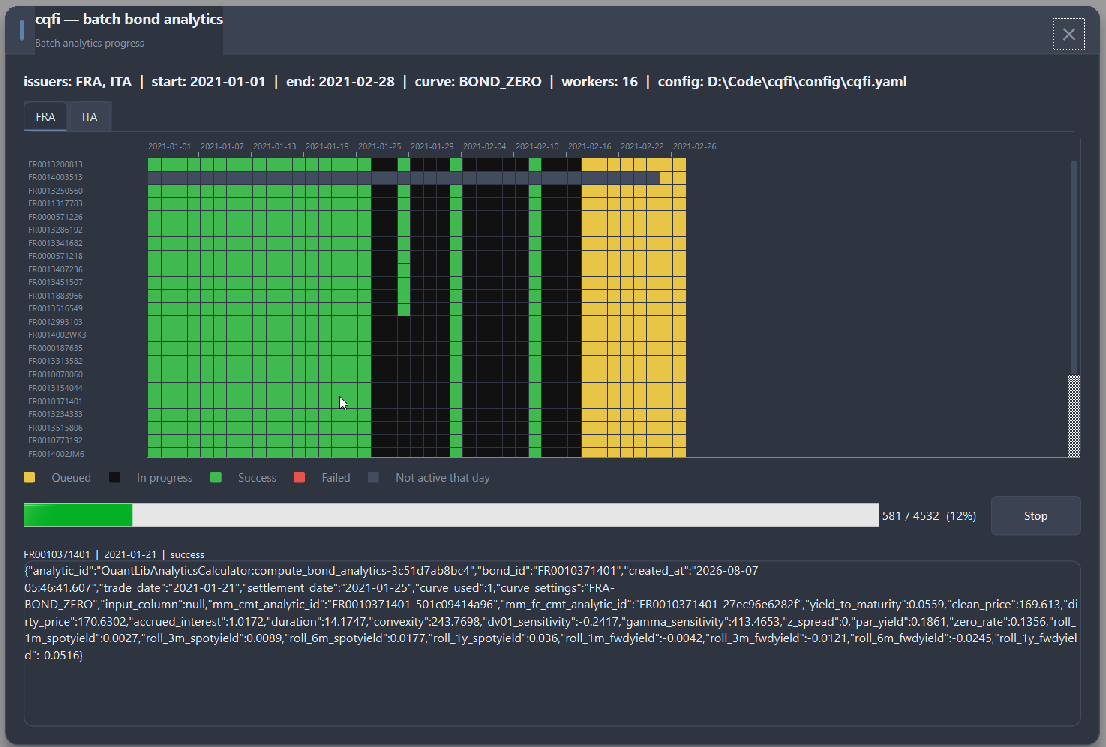
The progress window shows:
- One heatmap tab per issuer (bond mode) or future code (bond-future mode)
- Rows = bonds or dated contracts; columns = trade dates in the range
- Cell colours: queued (yellow), in progress (black), success (green), failed (red), not applicable that day (grey)
- Overall progress and a Stop button (cancels queued work and terminates worker processes; rows already written remain in the database)
- A detail pane: hover a green or red cell to see the JSON row written for that cell (floats rounded to four decimals in the display only). Ctrl+J copies the full compact JSON for the last hovered cell to the clipboard
Standalone CLI (batch_bond_analytics.py)
Bond mode — one or more issuers:
uv run batch_bond_analytics.py --config ./config/cqfi.yaml `
  --issuer FRA ITA --start 2020-01-01 --end 2020-12-31
Bond-future mode — one or more contract codes, optional delivery letters
(default HMUZ = Mar/Jun/Sep/Dec for each year spanned by the range):
uv run batch_bond_analytics.py --config ./config/cqfi.yaml `
  --future FGBX FGBM --delivery HMUZ `
  --start 2020-01-01 --end 2020-12-31
| Flag | Purpose |
|---|---|
--issuer CODE … |
Bond mode: issuer codes or aliases (mutually exclusive with --future) |
--future CODE … |
Bond-future mode: canonical or synonym codes (e.g. FGBM, IK) |
--delivery LETTERS |
Bond-future only: month letters to include (default HMUZ) |
--start, --end |
Inclusive trade-date range (YYYY-MM-DD) |
--curve-label |
BOND_ZERO (default) or BOND_PAR |
--workers N |
Process pool size (default min(cpu_count, 16)) |
--no-gui |
Text progress bar instead of the heatmap window (CI / headless) |
Only bonds active on a given trade date are scheduled (grey cells = not in the universe that day). Bond-future cells are skipped once the contract has delivered.
/batch slash command (cqfi / cqfi-gui)
Same engine and progress GUI as the standalone script, launched from the REPL
or GUI chat. Uses the session's loaded config (get_settings()); there is no
--config argument on the command itself.
cqfi> /batch FRA 2021-01-01 2021-02-28
cqfi> /batch FGBM HMUZ 2020-01-01 2020-12-31
| Form | Meaning |
|---|---|
/batch <issuer> <start> <end> |
All active bonds for one issuer, each business day in range |
/batch <future> <delivery> <start> <end> |
Dated contracts for one future code and delivery letters |
If /cache on, successful cells are written to both bond_analytics_db and
quant_cache_db; otherwise only bond_analytics_db. Query stored batch output
with the bond_analytics: dataset prefix (e.g. bond_analytics: show latest FRA bond analytics for January 2021).
VS Code / Cursor launch profiles for batch runs are listed under Debug configurations.
GUI usage (cqfi-gui)
uv run cqfi-gui
uv run cqfi-gui --config config/cqfi.yaml
The GUI uses the same config/cqfi.yaml, runtime JSON settings, dataset routing,
and slash commands (/bond, /mctx, /curve, /calc for bond or CMT analytics, /dlv,
/fut, /batch, /cache, /save_cache, /clean, …) as the CLI. Set ANTHROPIC_API_KEY in .env
for LLM-powered queries.
LLM Evaluation
The project includes a lightweight evaluation framework for testing the quality of --llm mode responses. Use it to:
- Detect regressions when prompt, semantics, or tool-description changes break existing behavior
- A/B test models by running identical scenarios against different Claude versions
- Verify multi-turn memory with conversational test sequences
- Root-cause failures using full tool-call traces (which SQL ran, what results came back)
- Build a golden set by turning unexpected CLI/GUI behavior into reusable test scenarios
Example:
from cqfi.evals import Scenario, Turn, no_tool_errors, contains_all
from cqfi.config import load_settings
from cqfi.evals import EvalRunner

scenario = Scenario(
    name="zero_rate_query",
    target="input",
    turns=[
        Turn(
            user_input="What was Germany's 10Y zero rate on 2020-01-02?",
            criteria=[
                no_tool_errors(),
                contains_all("DEU", "2020-01-02"),
            ],
        ),
    ],
)

app = load_settings()
runner = EvalRunner(app)
result = await runner.run_scenario(scenario)
Fast unit tests (no API key):
uv run pytest tests/test_evals_harness.py -v
Full end-to-end scenarios (requires ANTHROPIC_API_KEY):
uv run pytest -m llm_eval -v
For complete documentation, see docs/EVALUATOR.md.
Bond analytics (Python API)
The analytics layer is split into typed inputs/outputs and a QuantLib backend.
from datetime import date

from cqfi.analytics_input import BondAnalyticsInput
from cqfi.bond_manager import BondManager
from cqfi.numeric_term_structure import NumericTermStructure
from cqfi.quantlib.quantlib_analytics_calculator import QuantLibAnalyticsCalculator
from cqfi.quantlib.quantlib_market_context_manager import QuantlibMarketContextManager

market = QuantlibMarketContextManager.instance().get(date(2024, 1, 15), "DEU")

bond = BondManager.instance().get("usa10y001")
request = BondAnalyticsInput.from_bond(
    bond,
    trade_date=date(2024, 1, 15),
    repo_term_structure=NumericTermStructure(
        {"1m": 5.25, "3m": 5.10, "6m": 4.95, "1y": 4.80},
        as_of=date(2024, 1, 15),
    ),
)

calc = QuantLibAnalyticsCalculator()
bond_metrics, mm_cmt, mm_fc_cmt = calc.compute_bond_analytics(request, market)

print(bond_metrics.yield_to_maturity)
print(bond_metrics.z_spread)
print(mm_cmt.clean_price)         # maturity-matched par-yield CMT (~100)
print(mm_fc_cmt.clean_price)      # maturity-matched fixed-coupon CMT
print(bond_metrics.as_json())
When use_quant_cache is true (via /cache on or runtime JSON), the
@cache_bond_analytics decorator on compute_bond_analytics persists bond and
linked CMT rows to quant_cache_db; @cache_cmt_analytics on
compute_cmt_analytics persists standalone CMT rows to cmt_analytics.
| Field | Meaning |
|---|---|
yield_to_maturity, clean_price, dirty_price, accrued_interest |
Standard price/yield measures |
duration, convexity, dv01_sensitivity, gamma_sensitivity |
Risk metrics |
z_spread |
Z-spread to curve (bps) |
par_yield, zero_rate |
Par yield and curve zero at maturity (%) |
roll_*_spotyield, roll_*_fwdyield |
Roll-down metrics |
carry_* |
Yield minus repo rate from an optional NumericTermStructure |
CMT analytics (Python API)
Forward-starting CMTs use CmtAnalyticsInput and CompositeTenor. The coupon
is the par yield that prices the CMT at 100 clean at forward settlement.
from datetime import date

from cqfi.analytics_input import CmtAnalyticsInput
from cqfi.quantlib.quantlib_analytics_calculator import QuantLibAnalyticsCalculator
from cqfi.quantlib.quantlib_market_context_manager import QuantlibMarketContextManager

# From a combined tenor string (same parsing as /calc DEU 10y2y)
request = CmtAnalyticsInput.from_string("DEU", "10y2y", trade_date=date(2024, 1, 15))
market = QuantlibMarketContextManager.instance().get(date(2024, 1, 15), "DEU")

calc = QuantLibAnalyticsCalculator()
cmt_metrics = calc.compute_cmt_analytics(request, market)

print(cmt_metrics.clean_price)       # ~100 at par
print(cmt_metrics.yield_to_maturity)
print(cmt_metrics.par_yield)
CLI equivalent: /calc DEU 10y2y 2024-01-15
Bond futures (Python API)
Delivery baskets and basis analytics use their own typed input/output pair,
mirroring the bond/CMT analytics layer. BOND_FUTURE_CONVENTIONS is keyed by
canonical contract code (resolve_bond_future_convention also accepts
synonyms and Bloomberg roots); DeliveryBasket.auto pulls every eligible bond
from bond_universe, or build one bond-by-bond with .add(...).
from datetime import date

import QuantLib as ql

from cqfi.bond_futures import BOND_FUTURE_CONVENTIONS, BondFuture
from cqfi.bond_future_input import BondFutureInput
from cqfi.date_utils import to_ql_date
from cqfi.delivery_basket import DeliveryBasket
from cqfi.instruments import Bond
from cqfi.numeric_term_structure import NumericTermStructure
from cqfi.quantlib.quantlib_bond_future_calculator import QuantLibBondFutureCalculator
from cqfi.quantlib.quantlib_market_context import QuantLibCurveCollection, QuantlibMarketContext

trade_date = date(2026, 5, 15)
future = BondFuture(BOND_FUTURE_CONVENTIONS["FBTP"], 9, 2026)  # Sep-2026 Long-Term Euro-BTP

basket = DeliveryBasket(bond_future=future)
basket.add(Bond(issuer="ITA", maturity=date(2035, 4, 1), coupon=2.50,
                 user_friendly_id="ita035", issue_date=date(2015, 4, 1)))
basket.add(Bond(issuer="ITA", maturity=date(2036, 2, 1), coupon=4.00,
                 user_friendly_id="ita036", issue_date=date(2015, 4, 1)))

# One bond trades special in repo; give it its own curve. Everyone else
# finances at the basket-wide 3% flat rate passed to BondFutureInput below.
basket.set_repo_term_structure(
    basket.bonds()[0],
    NumericTermStructure({"3m": 1.0, "1y": 1.2}, as_of=trade_date),
)

ql.Settings.instance().evaluationDate = to_ql_date(trade_date)
curve = ql.YieldTermStructureHandle(
    ql.FlatForward(to_ql_date(trade_date), 0.03, ql.ActualActual(ql.ActualActual.ISDA))
)
collection = QuantLibCurveCollection(trade_date)
collection.set_bond_curve("ITA", curve)
market = QuantlibMarketContext()
market.set_curve_collection(collection, label="BOND_ZERO")

request = BondFutureInput.from_basket(
    basket, trade_date,
    repo_term_structure=NumericTermStructure({"1d": 3.0}, as_of=trade_date),
)
result = QuantLibBondFutureCalculator().compute_bond_future_analytics(request, market)

ctd = result.ctd()                                # cheapest-to-deliver first
print(ctd.bond.user_friendly_id, ctd.net_basis, ctd.implied_repo_rate)
print(result.to_polars())
print(result.as_json(indent=2))
| Field | Meaning |
|---|---|
conversion_factor |
Contract-specific CF; used verbatim when hard-coded, otherwise computed from the exchange formula |
clean_price, accrued_interest |
Curve-implied prices on the settlement date |
forward_clean_price |
Clean price carried to the delivery date at the resolved repo rate |
implied_repo_rate |
Return from buy-bond-deliver-repay; unaffected by the repo/carry assumption |
gross_basis, net_basis |
clean_price - futures_price * conversion_factor, and basis less carry |
delta, gamma |
Clean-price sensitivity to a parallel zero-curve shift, per basis point |
implied_fair_futures_price |
forward_clean_price / conversion_factor |
index |
Rank by implied repo rate; 0 is cheapest-to-deliver |
DeliveryBasket.add(bond, conversion_factor=None, repo_term_structure=None)
and set_repo_term_structure(bond, term_structure) cover the two per-bond
overrides; both default to basket-wide behaviour (computed CF, the basket-wide
repo curve, or the curve-forward fallback) when left unset. The CLI's /fut
repo argument only ever sets the basket-wide curve — per-bond overrides are
API-only for now.
CLI equivalent: /dlv myitabasket FBTP then /fut myitabasket 2026-05-15 3.0
Swap and repo curves (Python API)
Swap and repo curves share a similar shape — currency, coupon period(s),
index — but are keyed by different classes because they are used for
different things: SwapCurveKey names a fixed-for-floating swap par curve
(derivatives pricing), RepoCurveKey a repo / risk-free funding curve
(financing and discounting). Passing one where the other is expected raises
TypeError. Key fields are validated on construction.
from datetime import date

from cqfi.quantlib.quantlib_market_context import (
    REPO_RFR_LABEL,
    SWAP_PAR_LABEL,
    QuantlibMarketContext,
    RepoCurveKey,
    SwapCurveKey,
)

ctx = QuantlibMarketContext(as_of=date(2024, 1, 2))

swap_key = SwapCurveKey("USD", float_period="3M", fixed_period="6M")
swap = ctx.ensure_swap_curve(swap_key)          # also builds the USD repo curve
repo = ctx.ensure_repo_curve(RepoCurveKey("USD", period="3M"))

print(swap.discount(5.0), repo.discount(5.0))
print(ctx.curve_diagnostics[(SWAP_PAR_LABEL, swap_key)])   # pillar table
print(ctx.curve_collection(REPO_RFR_LABEL).repo_curve_keys())
Lower-level pieces, usable without a context:
| Function | Purpose |
|---|---|
rates_loader.load_swap_rates / load_repo_rates |
Long-form pillar rates for a key and date |
rates_loader.list_rate_curve_keys |
Distinct keys in swap_par_rates / repo_rfr_rates, optionally per date/currency |
quantlib_curve.ql_build_repo_curve |
Par-style bootstrap, self-discounting |
quantlib_curve.ql_build_swap_curve |
Swap bootstrap; pass a repo curve handle for dual-curve |
rate_conventions.resolve_currency_conventions |
Calendar, spot lag and day counts per currency |
Curve construction: pillars up to the float period use deposit helpers,
longer pillars use swap helpers against a generic IBOR-style index with the
float period's tenor, bootstrapped with PiecewiseLogCubicDiscount by
default (any QLZeroInterp piecewise member can be passed). The repo curve is
not yet used by bond-future carry or implied repo.
CLI equivalent: /curve swap USD 2024-01-02
Curve interpolation methods
Pass interpolation=QLZeroInterp.<METHOD> to ql_build_zero_curve /
price_cmts_from_rates (see quantlib/quantlib_curve.py).
| Family | Members | Rate type |
|---|---|---|
InterpolatedZeroCurve |
LINEAR_ZERO, CUBIC_ZERO*, NATURAL_CUBIC_ZERO, MONOTONE_CUBIC_ZERO |
ZERO |
PiecewiseYieldCurve |
LINEAR_ZERO**, CUBIC_ZERO, NATURAL_CUBIC_ZERO, KRUGER_ZERO, CONVEX_MONOTONE_ZERO, LOG_LINEAR_DISCOUNT, … |
PAR |
FittedBondDiscountCurve |
NELSON_SIEGEL, SVENSSON, EXPONENTIAL_SPLINES, SIMPLE_POLYNOMIAL, CUBIC_BSPLINES |
PAR |
* default for ZERO rate inputs · ** default for PAR rate inputs
Data Tables
bond_analytics_db (DuckDB or SQLite; path in config/cqfi.yaml) holds the
durable bond universe, cash-bond and CMT analytics, bond-future conventions, and
basis analytics. The schema is defined in semantics/bond_analytics.yaml and
materialised by create_bond_analytics_db.py (see the debug launch profiles in
.vscode/launch.json).
erDiagram
    tenor_pillars {
        TEXT issuer PK
        TEXT from_date PK
        TEXT currency
        TEXT to_date
        BOOLEAN pillar_flags "6M … 100Y"
    }

    bond_universe {
        TEXT bond_id PK
        TEXT user_friendly_id UK
        TEXT issuer
        TEXT currency
        REAL coupon
        TEXT maturity
        TEXT issue_date
        REAL issue_amount
        BOOLEAN is_green
    }

    cmt_analytics {
        TEXT cmt_analytic_id PK
        TEXT issuer
        TEXT tenor_label
        TEXT trade_date
        TEXT settlement_date
        TEXT maturity_date
        REAL coupon
        BOOLEAN is_fixed_coupon
        BOOLEAN curve_used
        TEXT curve_settings
        REAL yield_to_maturity
        REAL clean_price
        REAL duration
        REAL convexity
    }

    bond_analytics {
        TEXT analytic_id PK
        TEXT bond_id FK
        TEXT mm_cmt_analytic_id FK
        TEXT mm_fc_cmt_analytic_id FK
        TEXT trade_date
        TEXT settlement_date
        BOOLEAN curve_used
        TEXT curve_settings
        TEXT input_column
        REAL yield_to_maturity
        REAL clean_price
        REAL duration
        REAL convexity
        REAL z_spread
        REAL carry_roll "1m/3m/6m/1y carry & roll"
    }

    bond_future_conventions {
        TEXT convention_id PK
        TEXT exchange
        TEXT issuer
        REAL notional_maturity_years
        REAL notional_coupon
        REAL contract_size
        TEXT reference_day_spec
        TEXT delivery_start_spec
        TEXT delivery_end_spec
        TEXT conversion_factor_method
        TEXT repo_market
        TEXT synonyms
        TEXT restrictions_json
    }

    bond_future_basket_outputs {
        TEXT basket_output_id PK
        TEXT convention_id FK
        TEXT delivery_month
        TEXT trade_date
        TEXT settlement_date
        TEXT delivery_date
        REAL futures_price
        BOOLEAN futures_price_is_implied
        REAL repo_rate
        REAL bond_count
    }

    bond_future_outputs {
        TEXT future_output_id PK
        TEXT basket_output_id FK
        TEXT bond_id FK
        REAL index "CTD rank; 0 = cheapest"
        REAL conversion_factor
        REAL clean_price
        REAL accrued_interest
        REAL repo_rate
        TEXT repo_term_structure_json
        REAL forward_clean_price
        REAL implied_repo_rate
        REAL gross_basis
        REAL net_basis
        REAL delta
        REAL gamma
        REAL implied_fair_futures_price
    }

    bond_universe ||--o{ bond_analytics : "bond_id"
    cmt_analytics ||--o{ bond_analytics : "mm_cmt_analytic_id"
    cmt_analytics ||--o{ bond_analytics : "mm_fc_cmt_analytic_id"
    bond_future_conventions ||--o{ bond_future_basket_outputs : "convention_id"
    bond_future_basket_outputs ||--o{ bond_future_outputs : "basket_output_id"
    bond_universe ||--o{ bond_future_outputs : "bond_id"
Reading the diagram
| Table | Role |
|---|---|
tenor_pillars |
Valid CMT pillar set per issuer and date range (reference data). |
bond_universe |
Static bond reference data — populated from issuer CSVs at build time; looked up by /bond and /dlv. |
cmt_analytics |
Curve-priced CMT runs (standalone or as comparables for bonds). |
bond_analytics |
Per-bond analytics for a trade/settlement date; optional links to maturity-matched CMT rows. |
bond_future_conventions |
Exchange contract terms (one row per canonical code, e.g. FBTP, ZT); seeded from BOND_FUTURE_CONVENTIONS on merge. |
bond_future_basket_outputs |
One row per /fut run — contract, dates, futures price, basket-wide repo. |
bond_future_outputs |
Per-deliverable basis metrics within a basket, ranked cheapest-to-deliver first. |
tenor_pillars has no foreign keys to the other tables; it is joined logically
by issuer and pillar column names when building CMT schedules.
Link to semantics YAML
Each queryable database has a semantic profile under semantics/ that
drives three things: schema creation, LLM SQL planning (via mcp-data), and
column-level documentation for humans and agents.
| Database | Semantics file | Tables described |
|---|---|---|
ycs_data |
semantics/ycs_data.yaml |
zero/par rates, swap par rates, repo/RFR rates, FX, correlations |
bond_analytics_db |
semantics/bond_analytics.yaml |
all seven tables above |
quant_cache_db |
semantics/quant_cache.yaml |
session subset: bond_analytics, cmt_analytics, bond_future_basket_outputs, bond_future_outputs, plus calculation_log |
A semantics file is not just a column list. Each profile includes:
dataset/description— registered name and natural-language summary for mcp-data routing (bond_analytics:queries usebond_analytics.yaml).vocabulary— maps user phrases to stored values (e.g.United States→USA,10Y→ tenor labels). Issuer and currency codes align withissuers.pyand thebond_analytics.yamlvocabulary block.conventions— shared formatting rules (dates asYYYY-MM-DDtext, prices per 100, yields in percent).tables.<name>.columns— name, SQL type, and per-column description used when the LLM plans SQL and whencreate_bond_analytics_db.py/CacheRegistryemitCREATE TABLEDDL.examples— worked question → SQL pairs that teach mcp-data common access patterns.
Build path: python -m cqfi.data.create_bond_analytics_db reads
bond_analytics.yaml, creates tables in dependency order, loads
tenor_pillars and bond_universe from CSVs, and adds indexes declared in
create_bond_analytics_db.py (aligned to the YAML column names).
Runtime path: /calc and /fut write analytics rows to quant_cache_db
using the overlapping table definitions in quant_cache.yaml. With
/save_cache on, those rows upsert into bond_analytics_db; referenced
bond_future_conventions rows are upserted from the in-code
BOND_FUTURE_CONVENTIONS registry so foreign keys on
bond_future_basket_outputs resolve.
Paths to each semantics file are set in config/cqfi.yaml (ycs_semantics,
bond_analytics_semantics, quant_cache_semantics) and can be overridden with
CQFI_*_SEMANTICS environment variables.
Architecture
flowchart TD
    User["👤 User<br/>cqfi / cqfi-gui"]

    User -->|Direct commands| DCmd["Direct Commands<br/>price cmt, /bond,<br/>/mctx, /curve, /calc,<br/>/dlv, /fut,<br/>/cache, save/load"]
    User -->|LLM queries| LLM["LLM Agent<br/>mcp-data +<br/>extra tools"]
    User -->|Rule syntax| Rules["Rule-based SQL<br/>tables, schema,<br/>sql: SELECT"]

    DCmd --> Router["🔀 Query Router<br/>input / cache / bond_analytics"]
    LLM --> Router
    Rules --> Router

    Router --> YCS["📊 ycs_data<br/>read-only curves"]
    Router --> Bond["📚 bond_analytics_db<br/>bond_universe,<br/>durable analytics,<br/>bond future conventions"]
    Router --> Cache["⚡ quant_cache_db<br/>session analytics,<br/>cmt_analytics"]

    YCS --> MktCtx["🌍 QuantlibMarketContextManager<br/>bond, swap & repo curves,<br/>FX, context"]
    Bond --> MktCtx
    Cache --> CacheMgr["💾 CacheManager<br/>sessions,<br/>@cache_bond_analytics,<br/>@cache_cmt_analytics"]

    MktCtx --> Calc["🧮 QuantLibAnalyticsCalculator<br/>pricing, analytics, CMT"]
    MktCtx --> FutCalc["📐 QuantLibBondFutureCalculator<br/>conversion factor, basis, CTD"]
    CacheMgr --> Calc
    Bond --> Basket["🧺 DeliveryBasket<br/>eligibility, CF/repo overrides"]
    Basket --> FutCalc

    Calc --> Result["✅ Results<br/>metrics, prices,<br/>analytics"]
    FutCalc --> Result
Configuration layers:
| Layer | Location | Contents |
|---|---|---|
| Static paths | config/cqfi.yaml + env overrides |
DB paths, semantics YAML, sessions dir |
| Runtime toggles | ~/.cqfi/cqfi_runtime.json |
use_quant_cache, save_quant_cache_to_bond_analytics_after_session |
Key design points:
AppSettings(config.py) resolves paths, validates that the three DB and three semantics paths are distinct, and registers MCP datasets with routing keywords.RuntimeSettings(config.py) holds mutable cache behaviour; slash commands update and persist it.finalize_quant_cache_sessionruns on application exit to merge or discardquant_cache_dbanalytics.QuantlibMarketContextManagerlazily builds curves fromycs_data.SwapCurveKey/RepoCurveKey(curve_keys.py) key currency-level curves;QuantlibMarketContext.ensure_swap_curve/ensure_repo_curvebuild them on demand with conventions fromrate_conventions.py.QuantLibAnalyticsCalculator.compute_bond_analyticsreturns(bond_metrics, mm_cmt_metrics, mm_fc_cmt_metrics)and optionally persists via@cache_bond_analyticswhenuse_quant_cacheis enabled.QuantLibAnalyticsCalculator.compute_cmt_analyticsprices a forward-starting CMT from aCompositeTenorand optionally persists via@cache_cmt_analytics.BOND_FUTURE_CONVENTIONS(bond_futures.py) is a static registry of contract templates;resolve_bond_future_conventionlooks one up by canonical code, synonym, or Bloomberg root.DeliveryBasket(delivery_basket.py) holds the deliverable bonds for a datedBondFuture, checked against the contract'sBasketRestrictions, with optional per-bond conversion-factor and repo-term-structure overrides.QuantLibBondFutureCalculator.compute_bond_future_analyticsreturns aBondFutureBasketOutput(per-bondBondFutureOutputs, cheapest-to-deliver first) and, whenuse_quant_cacheis enabled, persists rows tobond_future_basket_outputs/bond_future_outputsinquant_cache_db. On exit with/save_cache on, those rows merge intobond_analytics_db(conventions upserted fromBOND_FUTURE_CONVENTIONS).CacheRegistrymaterialisesbond_analytics,cmt_analytics, and bond future basket/output tables inquant_cache_dbfromsemantics/quant_cache.yaml.Semantics YAML (
semantics/) describes each database for mcp-data so the LLM can plan SQL without hard-coded schema knowledge.
Additional datasets can be registered in cqfi.yaml under a top-level
datasets: block — no code changes required.
Project layout
src/cqfi/
  config.py                         — AppSettings, RuntimeSettings, path validation
  issuers.py                        — 19 sovereign IssuerProfile conventions
  instruments.py                    — Bond dataclass (from bond_universe rows)
  bond_manager.py                   — singleton bond lookup cache
  composite_tenor.py                — CompositeTenor (forward-start CMT tenors)
  tenor.py                          — Tenor parse/simplify/calendar math
  numeric_term_structure.py         — tenor → rate mappings (repo curves, etc.)
  curve_keys.py                     — SwapCurveKey, RepoCurveKey (validated)
  rate_conventions.py               — per-currency swap/repo conventions
  analytics_input.py                — BondAnalyticsInput, CmtAnalyticsInput
  analytics_output.py               — FixedIncomeAnalyticsOutput
  analytics_calculator.py           — AnalyticsCalculator protocol
  bond_futures.py                   — BOND_FUTURE_CONVENTIONS registry, BondFuture, BasketRestrictions
  delivery_basket.py                — DeliveryBasket, BasketMember, /dlv and /fut CLI parsing
  bond_future_input.py              — BondFutureInput
  bond_future_output.py             — BondFutureOutput, BondFutureBasketOutput
  bond_future_calculator.py         — BondFutureCalculator protocol
  day_of_month.py                   — DayOfMonthSpec (reference/delivery day rules)
  cli_tools.py                      — get_bond, check_market_context, compute_bond_analytics, compute_cmt_analytics, build_delivery_basket, compute_bond_future_analytics, get_curve, list_curves, /calc /dlv /fut /curve parsing
  batch/                            — batch planner, process-pool engines, /batch command parsing
  agent/
    cli.py                          — cqfi REPL, slash commands, query routing
    planner.py                      — rule/LLM query planning
  quantlib/
    quantlib_curve.py               — curve construction (QLZeroInterp enum)
    quantlib_market_context.py      — curve collections, FX, context builder
    quantlib_market_context_manager.py
    quantlib_analytics_calculator.py
    quantlib_bond_future_calculator.py — conversion factor, basis, CTD analytics
    quantlib_conversion_factor.py   — exchange CF formulas (CME, EUREX, ICE, JGB)
    cmt.py                          — CMT pricing (no cache write)
  data/
    rates_loader.py                 — read zero/par/swap/repo rates from ycs_data
    create_bond_analytics_db.py     — build/populate bond_analytics DB
  cache/
    manager.py                      — CacheManager, sessions, CMT pricing entry
    registry.py                     — bond_analytics / cmt_analytics in quant_cache_db
    decorators.py                   — @cache_bond_analytics, @cache_cmt_analytics
    session_finalize.py             — merge or discard cache on exit
  gui/
    app.py                          — cqfi-gui entry point
    chat_dialog.py                  — chat + result rendering (slash command parity)
config/cqfi.yaml                    — static path config
semantics/
  ycs_data.yaml
  bond_analytics.yaml
  quant_cache.yaml
notebooks/
  bond_and_bond_future_analytics.ipynb  — API tutorial (registry + user-built objects)
Debug configurations (Cursor / VS Code)
Five launch profiles are defined in .vscode/launch.json:
| Name | What it runs |
|---|---|
cqfi |
CLI interactive REPL |
cqfi: one-shot query |
CLI with a single query argument (edit in launch.json) |
cqfi: price CMT |
CLI pricing smoke-run (USA 2020-01-02) |
cqfi-gui |
GUI window (uses config/cqfi.yaml) |
cqfi-gui: custom config |
GUI window with explicit --config flag |
batch_bond_analytics: … (CLI) |
Standalone batch script (bond or bond-future args in launch.json) |
cqfi: /batch … (LLM one-shot) |
REPL one-shot /batch → progress GUI |
Dependencies
Local editable packages (via pyproject.toml [tool.uv.sources]):
- framecache — optional SQLite blob cache (when
quant_cache_dbis SQLite) - mcp-data — natural-language SQL planning
- decorules — declarative validation decorators
PyPI: QuantLib, polars, pyside6, plotnine, pyyaml, python-dotenv,
duckdb, anthropic
Installing Cqfi
This server has no published package — it is built from source. Open the repository and follow its README.
▸ github.com/FulgentMcGuffin/cqfiFAQ
Is Cqfi MCP free?
Yes, Cqfi MCP is free — one-click install via Unyly at no cost.
Does Cqfi need an API key?
No, Cqfi runs without API keys or environment variables.
Is Cqfi hosted or self-hosted?
Self-hosted: the server runs locally on your machine via the install command above.
How do I install Cqfi in Claude Desktop, Claude Code or Cursor?
Open Cqfi on unyly.org, pick your client tab (Claude Desktop, Claude Code, Cursor) and press Install — the config is generated automatically, no JSON editing.
Related MCPs
Gmail
Read, send and search emails from Claude
 by Google
Slack
Send, search and summarize Slack messages
 by Slack
Runbear
No-code MCP client for team chat platforms, such as Slack, Microsoft Teams, and Discord.
Discord Server
A community discord server dedicated to MCP by [Frank Fiegel](https://github.com/punkpeye)
Klavis AI
Open Source MCP Infra. Hosted MCP servers and MCP clients on Slack and Discord.
Work90210/APIFold
Turn any REST API into a hosted MCP server, with ready-made public servers for GitHub, Stripe, Slack, OpenAI, Notion and more.
 by Work90210
arikusi/deepseek-mcp-server
DeepSeek AI chat and reasoning with multi-turn sessions, function calling, thinking mode and cost tracking.
 by arikusi
hashgraph-online/hashnet-mcp-js
Discover, register and chat with AI agents on the Hashgraph network via the Registry Broker.
 by hashgraph-online
profullstack/mcp-server
Developer utilities: SEO optimization, document conversion, domain lookup, email validation, QR codes, weather data, social media posting and security scanning.
 by profullstack
WayStation-ai/mcp
Connect MCP hosts to apps such as Notion, Slack, Monday and Airtable.
 by waystation-ai
Compare Cqfi with
Not sure what to pick?
Find your stack in 60 seconds
Author?
Embed badge for your README
Browse similar
All communication MCPs