
Aitiome
FreeNot checkedMechanistic-reasoning engine for the environmental exposome of neurodegeneration. Uses AI to recover causal pathways for Parkinson's and Alzheimer's.

About
Mechanistic-reasoning engine for the environmental exposome of neurodegeneration. Uses AI to recover causal pathways for Parkinson's and Alzheimer's.
README
An honest mechanistic-reasoning engine for the environmental exposome of neurodegeneration.
Go · React 18 + TypeScript + Vite · Three.js / GLSL · MCP · Claude Opus 4.8 · MIT · Built with Claude: Life Sciences
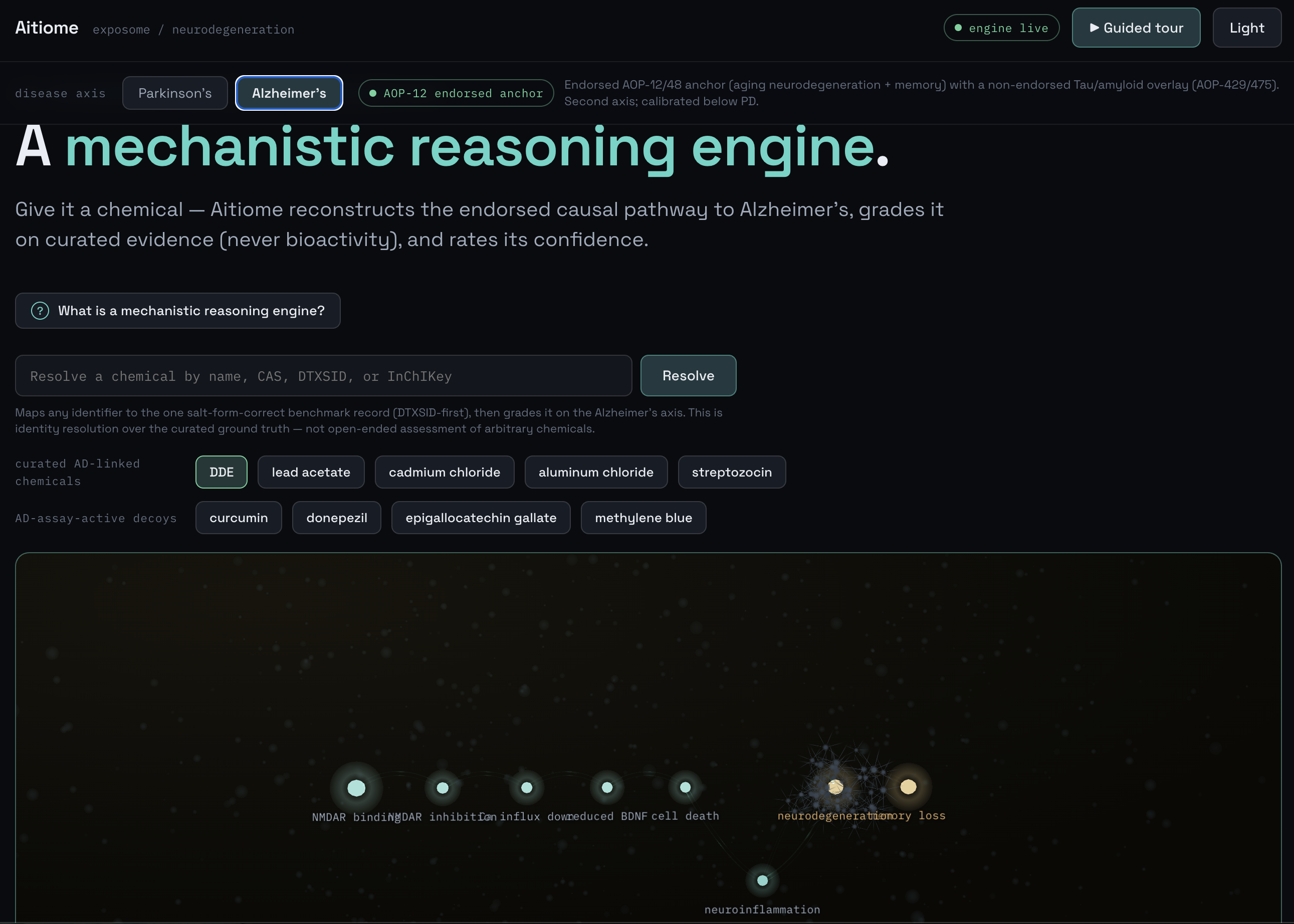
Submitted by Jon Radoff for the Built with Claude: Life Sciences hackathon.
Give Aitiome a chemical and it reconstructs the OECD-endorsed causal pathway — molecular initiating event (MIE) → key events (KE) → adverse outcome (AO) — to a Parkinson's or Alzheimer's hallmark, grades it on curated evidence (never bioactivity), and rates its confidence. It proves itself two ways at once: it recovers the known neurotoxicants on the endorsed scaffold, and it refuses to be fooled by bioactive compounds that are not neurotoxic.
It is not a system that claims to discover novel neurodegeneration-causing chemicals. It is transparent about exactly where AI-driven discovery is, and is not, possible on this chemical class — and it ships that honesty as a feature.
▶ Try it live
- App → https://aitiome.fly.dev
- Presentation deck → https://aitiome.fly.dev/presentation.pdf
Click a known neurotoxicant to watch the endorsed cascade reconstruct and ignite the vulnerable dopaminergic-neuron terminal. Click a bioactive decoy to see it withheld and rejected on independent lines of evidence.
A methods result: how should Claude synthesize scientific evidence?
Alongside the engine, we studied how Claude should assemble scientific evidence — comparing four methods (RAG, RAG+, RLM, RLM-ADV) on one shared, deterministic scorer across six chemicals.
Adversarial RLM (RLM-ADV) surfaced ~10× more counter-evidence than RAG and ~2.2× more than the strong RAG+ baseline — while matching RAG+ on yield and source breadth, running under a degraded web-search backend. Surfacing disconfirming evidence is precisely the property a calibrated-honesty tool needs most.
Conclusion: adversarial RLM is the right synthesis method for this life-science evidence-assembly use case. See the live RLM page and docs/research/rlm/FINDINGS.md.
What we presented
The full narrative, live product tour, and figures are in the hosted deck. The essentials:
The problem. The large majority of Parkinson's (PD) and Alzheimer's (AD) is sporadic, not inherited. A major, understudied contributor is the environmental exposome — the pesticides, metals, and industrial chemicals we meet over a lifetime. In 2024 the field's leaders (Miller, Barouki, Samieri; Nature Neuroscience) called for AI that connects chemicals to disease mechanism.
Why it's hard. Tens of thousands of chemicals are bioactive — they light up assays. Very few have curated evidence for human neurodegeneration. The entire difficulty is telling a true neurotoxicant apart from a compound that is merely bioactive. That is the exact failure mode of activity-based screening, and Aitiome is built to win that one discrimination.
The recovery rule (the core discipline).
positive <=> ( CTD curated Parkinson's DirectEvidence ) OR ( registered neuro-AOP stressor )
Curated signals are diagnostic. Assay/bioactivity activity is corroboration only and anti-diagnostic: it illustrates mechanism for known positives but cannot discriminate, so the engine never gates a positive call on it.
The validation result (on the reconnaissance ground truth):
| axis | recovered | negatives rejected | adversarial decoys rejected | false positives | false negatives |
|---|---|---|---|---|---|
| Parkinson's | 13 / 13 | 15 / 15 | 6 / 6 | 0 | 0 |
| Alzheimer's | 12 / 12 | ✓ | ✓ | 0 | 0 |
The 6 adversarial decoys are mitochondria-active, non-neurotoxic compounds designed to fool an activity model (troglitazone, prochloraz, propiconazole, simvastatin, fenofibrate, warfarin). Recovery is the sanity check; the 6/6 decoy rejection is the contribution — always read the two together.
The falsification. Computed live from our own data: the AUROC of every bioactivity signal separating the positives from the adversarial decoys is at or below chance (0.5) — mitochondrial assays 0.16, membrane potential 0.12, oxidative stress 0.20, mechanistic assays 0.39, ToxCast-active 0.15. The decoys are, if anything, more bioactive than the real neurotoxicants. Bioactivity is anti-diagnostic here; the curated rule is perfect on the same set.
The honest discovery map. We tested seven independent discovery axes (transcriptomics, morphology, structure/QSAR, full bioactivity fingerprints, knowledge graphs, physics-based docking). Every one was coverage-killed (environmental toxicants aren't profiled in drug-centric databases) or confounder-killed (general bioactivity is not neurotoxicity). That reproducible negative result is shipped as a first-class map, never disguised as a predictor.
The candidate triage queue. The honest form of the original discovery goal: an evidence-weighted priority queue of chemicals with real-but-incomplete evidence, each with its evidence strands, distance-to-gate, and a recommended next experiment for a wet lab. The ranking never decides — only the curated gate promotes. The six decoys are carried as a permanent control and rank last; a held-out backtest recovers a known positive (TCE/DDE) from non-curated strands alone, above every decoy: prioritization skill, not causal discovery.
Two disease axes. The identical curated-diagnostic engine runs on both PD (endorsed AOP-3 anchor) and AD (endorsed AOP-12/48 anchor + a non-endorsed Tau/amyloid overlay). Honesty is by calibration, not less rigor: AD's weaker spots are surfaced in the UI compare matrix.
Technical architecture & features
The whole app ships as one ~13 MB Go binary that serves the web UI, the /api/* HTTP API, and — as a
sibling adapter — an MCP server. The design is a transport-agnostic service layer (all domain logic in
one Go package, services/aitio) with thin HTTP and MCP adapters over the identical service methods. A
scientist and an external agent drive the same engine — the dual human + agent interface is a core pillar.
                 +------------------------------------------------------+
                 |  contract/  (the seam: types + fixtures, versioned)  |
                 |  goapi (Go) . ts (TypeScript) . fixtures/ . VERSION  |
                 +------------------------------------------------------+
                       ^                                        ^
        imports        |                                        |  imports (types + fixtures)
   +-------------------------------------+          +-------------------------------------+
   |  services/  (Go)                    |          |  web/  (React + TS + Three.js)      |
   |  aitio (one service package)        |   /api   |  hero/  GLSL cascade + neuron       |
   |   resolver . aop . recovery         | <------- |  components/  evidence, trace,      |
   |   evidence . validation . reasoner  |  proxy   |    validation, discovery, MCP, ...  |
   |  cmd/httpd (HTTP)  cmd/mcpd (MCP)    |          |  data layer (live first, fixtures)  |
   +-------------------------------------+          +-------------------------------------+
- Deterministic core, no LLM in the decision path. The pipeline is a fixed sequence — resolve → curated gate → reconstruct the endorsed AOP → converge evidence → rank candidates → falsify against the decoys. It is deterministic over curated data: same input, same output, auditable, reproducible.
- Claude Opus 4.8 evidence-reasoner. An
EvidenceReasonerwrites a calibrated,[E#]-cited prose synthesis of each completed assessment. It is hard-bounded to explain, never decide: it cannot change the call or the tier. A deterministic direct reasoner is the always-available fallback, so the endpoint works without an API key. Model is configurable per role. - Core ⟂ visualization split behind a versioned
contract/(typed Go + TypeScript schema + fixtures). The visualization runs entirely on contract fixtures; integration is a fixture-to-live flip. - React 18 + TypeScript + Vite frontend with a Three.js / GLSL hero visualization: an exposome particle field, evidence-weighted glowing cascade edges, the SOX6/AGTR1 dopaminergic-neuron terminal igniting for positives, rejection rings for decoys. Dark mode by default, light-mode parity.
go:embedcurated data, deterministic at load: CTDDirectEvidence, AOP-Wiki, MitoCarta3.0, Kamath 2022, ToxCast / NICEATM ICE (corroboration only), openFDA FAERS, and B3DB for brain exposure.- Correctness spine: DTXSID-first, salt-form-correct identity resolution — not PubChem-synonym guessing (the paraquat-dichloride trap, test-locked).
MCP — the agentic interface. The built-in MCP server exposes the same engine as 13 tools an external
agent can drive, getting the same graded, cited call a scientist does. Full reference: mcp.md and
the live MCP page. The Claude Science curation workflow (make curate /
assess_curated) is documented in docs/claude-science.md.
MCP working examples
Representative tool calls and their (illustrative) results. The engine is deterministic, so a given input yields a stable result; the JSON below is trimmed for readability.
assess_compound — resolve → curated gate → reconstructed AOP → confidence
// tool: assess_compound  { "id": "rotenone", "disease": "pd" }
{
  "compound": { "name": "Rotenone", "dtxsid": "DTXSID6021248", "cas": "83-79-4" },
  "call": "positive",
  "diagnostic": true,
  "gatedOnAssay": false,                         // <- bioactivity NEVER gates the call
  "confidenceTier": "assay_mechanism_recovered",
  "gate": { "ctdDirectEvidence": true, "aopStressorOf": ["AOP-3"] },
  "pathway": {                                    // the endorsed cascade, reconstructed
    "aop": "3",
    "chain": ["MIE 888", "KE 887", "KE 177", "KE 890", "AO 896"]
  },
  "bioactivity": { "role": "corroboration_only" } // illustrates mechanism; not diagnostic
}
list_candidates — the evidence-weighted triage queue
// tool: list_candidates  { "disease": "pd" }
{
  "queue": [
    { "name": "Fenpyroximate", "score": 8, "distanceToGate": "gate-ready AOP-3 stressor",
      "nextExperiment": "confirm registered stressor status / CTD DirectEvidence" }
    // ... ranked, non-bioactivity strands only ...
  ],
  "decoyControl": [
    { "name": "Propiconazole", "score": 0, "note": "adversarial decoy — MUST rank last" }
  ],
  "backtest": { "recovered": "TCE / DDE", "fromCuratedStrands": false, "aboveAllDecoys": true }
}
The queue is a triage layer, not a predictor — only the curated gate promotes; decoys are a permanent control that must rank last; the held-out backtest recovers a known positive from non-curated strands alone.
benchmark — the falsification harness
// tool: benchmark  {}
{
  "curatedRule": { "falsePositives": 0, "falseNegatives": 0 },   // perfect on the same set
  "bioactivityAUROCvsDecoys": {
    "mitochondrial": 0.16, "membranePotential": 0.12,
    "oxidativeStress": 0.20, "mechanisticTotal": 0.39, "toxCastActive": 0.15
  },
  "verdict": "every bioactivity signal at or below chance (0.5); bioactivity is anti-diagnostic"
}
The empirical answer to "you're just detecting bioactivity": the curated rule separates perfectly while every activity signal is at or below chance against the decoys.
All 13 MCP tools: health · list_compounds · diseases · resolve_compound · assess_compound ·
run_validation · list_candidates · synthesize_assessment · assess_curated · sources · benchmark ·
discovery_map · get_pathway.
Installation, build & run
Prerequisites: Go 1.26+ and Node 22+. For the optional Claude synthesis, copy .env.example to .env and
set ANTHROPIC_API_KEY (default reasoner model claude-opus-4-8, configurable via AITIO_MODEL_REASONER).
Everything else works without a key.
Dev workflow
./run.sh                     # builds + starts the engine (:8787) and the web app
# open http://localhost:5273
run.sh builds the Go engine, starts the HTTP API on :8787, and launches the Vite dev server on :5273
(the web app proxies /api to the engine and falls back to fixtures). To run pieces individually:
make run-http                # HTTP API on :8787
make run-mcp                 # MCP server over stdio
cd web && npm install && npm run dev   # frontend dev server on :5273
Production build (single binary: API + web UI)
The engine also serves the built web UI, so the whole app ships as one binary / one container.
cd web && npm run build && cd ..
go build -o bin/httpd ./services/cmd/httpd
AITIO_WEB_DIR=web/dist ./bin/httpd            # serves API + UI on :8787
Docker
docker build -t aitiome .
docker run -p 8787:8787 -e ANTHROPIC_API_KEY=sk-ant-... aitiome
Without the key the Claude evidence-reasoner falls back to the deterministic one; everything else is identical.
Deploy (fly.io)
Production runs on fly.io. See docs/deploy.md for the full launch + secret + custom-domain steps.
fly launch --no-deploy --copy-config --name aitiome
fly secrets set ANTHROPIC_API_KEY=sk-ant-...      # never commit the key
fly deploy
Make targets
make test        # Go tests (harness fp=fn=0, salt-form guard, decoy rejection, synthesis)
make validate    # judge-facing red-team report (bioactivity AUROC vs decoys, invariants)
make fixtures    # regenerate contract/fixtures from the live engine
make curate NAME=ziram   # Claude + web-search curation agent -> engine grade (a hypothesis until verified)
HTTP endpoints
/health /compounds /diseases /resolve?id= /assess?id=[&disease=] /synthesis?id= /validation
/benchmark /sources /pathway[?aop=3] /discovery-map /candidates POST /assess-curated
Project layout
contract/     the versioned core<->viz seam: goapi (Go), ts (TypeScript), fixtures/, VERSION
services/     Go: aitio service package + cmd/httpd (HTTP) + cmd/mcpd (MCP) adapters
web/          React + TypeScript + Three.js app (hero/ + components/), runs live or on fixtures
docs/         the reconnaissance assets, the master brief, decision records, and the RLM findings
learnings.md  a running log of what we learned building + red-teaming (findings, open critiques)
CLAUDE.md     always-loaded constraint memory: the settled recon findings and the hard rules
run.sh        one command to build and start everything
Honesty guardrails
Aitiome outputs evidence-ranked mechanistic hypotheses, never claims of causation. Confidence tiers appear on every result. The recovery decision is curated and never gated on bioactivity. The discovery limits are surfaced, not hidden. Recovery is a sanity check; the adversarial 6/6 decoy rejection is the contribution.
Data sources retain their own licenses and citation requirements (notably CTD, which is non-commercial and citation-required). Access routes are recorded per source in docs/recon/data-source-map.md and surfaced in the app's provenance drawer.
License & credits
MIT License — © 2026 Jon Radoff. See LICENSE.
Built with Claude — Claude Code built the system, the Claude API (Opus 4.8) writes the cited synthesis, and Claude Science assembles and verifies the curated evidence. Created for the Built with Claude: Life Sciences hackathon.
Installing Aitiome
This server has no published package — it is built from source. Open the repository and follow its README.
▸ github.com/jonradoff/aitiomeFAQ
Is Aitiome MCP free?
Yes, Aitiome MCP is free — one-click install via Unyly at no cost.
Does Aitiome need an API key?
No, Aitiome runs without API keys or environment variables.
Is Aitiome hosted or self-hosted?
Self-hosted: the server runs locally on your machine via the install command above.
How do I install Aitiome in Claude Desktop, Claude Code or Cursor?
Open Aitiome on unyly.org, pick your client tab (Claude Desktop, Claude Code, Cursor) and press Install — the config is generated automatically, no JSON editing.
Related MCPs
GitHub
PRs, issues, code search, CI status
 by GitHub
Filesystem
Secure file operations with configurable access controls.
Memory
Knowledge graph-based persistent memory system.
Template MCP Server
A CLI tool to create a new Model Context Protocol server project with TypeScript support, dual transport options, and an extensible structure
 by mcpdotdirect
Amap Maps Mcp Server
MCP server for using the AMap Maps API
 by duxiaohui
Supabase
Database, auth and storage
 by Supabase
Everything
Reference / test server with prompts, resources, and tools.
Git
Tools to read, search, and manipulate Git repositories.
Sequential Thinking
Dynamic and reflective problem-solving through thought sequences.
Time
Time and timezone conversion capabilities.
Compare Aitiome with
Not sure what to pick?
Find your stack in 60 seconds
Author?
Embed badge for your README
Browse similar
All development MCPs